
Agentic Commerce: How AI Shopping Agents Work in 2026
A practical guide to agentic commerce: product comparison, checkout integrations, authorization, failure handling and a controlled first pilot for merchants.

- 9 Min Read
- Jun 29, 2026
- 272 Views
- What is agentic commerce?
- How AI shopping agents work
- Discovery, checkout and commerce protocols
- Product data and current offers serve different roles
- The merchant architecture behind a reliable transaction
- Authorization, payment and failure handling
- Fashion and marketplace use cases
- How agentic commerce differs from GEO
- A practical first pilot
- Frequently asked questions
- How CodeNdCoffee can support the foundations
Agentic commerce is a shopping workflow in which an AI assistant uses connected tools to help a customer research products, compare offers and, where supported and authorized, take purchasing actions. Recommendation, cart creation and payment are separate capabilities; an assistant that can find a product cannot necessarily buy it.
Think about the last time you bought something online. You probably searched, opened several websites, compared specifications, read reviews and checked delivery dates. An AI shopping assistant can help coordinate parts of that work, but its usefulness depends on the information and actions it can actually access.
For e-commerce founders and technical teams, the practical question is which part of that journey to support. This guide explains the workflow, the systems behind it and the limits that matter before connecting an assistant to checkout. It replaces broad predictions about 2026 with implementation considerations merchants can evaluate today.
What is agentic commerce?
In agentic commerce, a customer delegates a bounded shopping task to software that can interpret requirements and use tools to work toward the goal. Those tools may search a catalog, retrieve an offer, calculate delivery options or prepare a checkout session.
The customer still needs meaningful control over the purchase. A budget or product preference does not automatically authorize every seller, substitution, subscription or payment method.
- Product discovery: finding candidate products through pages, search results or supported feeds.
- Decision support: comparing verified facts and explaining trade-offs.
- Purchasing actions: preparing or completing a transaction through a compatible integration with appropriate authorization.
These capabilities can be combined, but availability varies by provider, merchant, market and implementation. Avoid assuming that every assistant searches all stores or can complete every checkout.
How AI shopping agents work
Consider this illustrative request from the original article:
“Find me a black leather backpack under $250 that fits a 16-inch laptop and can be delivered before Friday.”
A well-designed workflow needs more than matching the words “black backpack.” It must distinguish hard constraints from preferences and obtain enough information to test them.
- Clarify the request: confirm the delivery destination, currency, intended laptop dimensions and any non-negotiable requirements.
- Find candidates: retrieve products from the sources available to the assistant. State the coverage limitations rather than claiming an exhaustive market search.
- Check evidence: verify material, internal dimensions, variant, price and availability. An image or marketing phrase is not sufficient proof of fit.
- Compare offers: show relevant costs, delivery estimates and return conditions, with unresolved details clearly identified.
- Prepare checkout: use the supported merchant integration to obtain a current quote, including shipping and applicable charges.
- Obtain authorization: present the exact item, seller, quantity and total for confirmation before the purchasing action.
- Verify the result: return a confirmed order reference or an explicit failure state. A submitted request is not the same as a completed order.
The assistant should ask for clarification or hand the shopper to the merchant when it cannot establish an essential constraint. It should not turn a dispatch estimate into a guaranteed arrival date.
Discovery, checkout and commerce protocols
Product discovery can use public pages or supported feeds. It does not universally require a merchant to expose a new API. Transactional integration is a different task: the system needs a documented way to manage a checkout session and its permitted actions.
One current example is Google’s Universal Commerce Protocol implementation. Google’s documentation describes UCP as an open standard for agentic commerce, with native checkout and an optional embedded path for approved merchants. Its onboarding and supported capabilities should be checked before planning a launch.
This is an example of a specific integration, not proof that all assistants use UCP or that every merchant is eligible. Confirm supported markets, product categories, payment options and post-purchase behavior with the chosen provider.
Model Context Protocol can expose tools to compatible AI applications. MCP alone does not provide a complete commerce checkout or payment authorization system. Choose interfaces around the actual channel requirements rather than adopting a protocol because it mentions agents.
Product data and current offers serve different roles
Clear product titles, descriptions, specifications, materials, sizes, colors and dimensions help shoppers compare candidates. Genuine reviews and accessible policies provide additional context. Keep every product claim traceable to evidence.
Product facts and offer facts should be managed separately. A bag’s dimensions may change rarely; its price, promotion and availability can change during a conversation. Revalidate the selected variant and offer at checkout rather than relying on an earlier answer or cached listing.
AI product data enrichment can support structured attributes and review workflows. It should flag missing evidence rather than inventing brand, material, condition or certification details.
For stores serving the US and Europe, quotes need the correct currency, destination and regional policies. Explain what is included in the total and which delivery estimates depend on location. Do not treat one market’s offer as globally available.
The merchant architecture behind a reliable transaction
A useful integration connects the assistant to a controlled commerce layer rather than giving it broad administration access. The store’s existing systems remain responsible for inventory, pricing rules, payment processing and fulfillment.
- Catalog layer: stable product and variant identifiers with verified attributes.
- Offer layer: current price, availability, shipping options and quote validity.
- Checkout layer: validated quantities, customer choices and authorized purchasing actions.
- Order layer: persistent transaction state, duplicate prevention and clear confirmation.
- Operations layer: fulfillment updates, exception handling and customer support.
E-commerce middleware development connects these layers with warehouse, supplier and marketplace systems. Monitor update delays and reconciliation failures; a successful API response does not establish that every channel is current.
A shopping assistant needs permission to retrieve offers or prepare checkout, not permission to edit the merchant’s pricing rules. Keep customer-facing shopping tools separate from internal AI agents for commerce operations.
Authorization, payment and failure handling
Agentic commerce introduces additional failure points between a shopper’s intent and a completed order. Design these controls before enabling purchasing actions:
- Bind approval to the exact seller, variant, quantity, destination and total. Ask again if material details change.
- Use approved payment infrastructure and scoped credentials. Avoid putting raw payment details in prompts or routine logs.
- Recheck availability and quote validity before committing an order.
- Prevent duplicate transactions when a request times out or is retried. Check the existing outcome before repeating a write.
- Keep product descriptions, reviews and external messages as untrusted data. Instructions inside them must not override the shopper’s authorization.
- Provide a human checkout or support route for uncertain, rejected or unsupported transactions.
Retain enough evidence to investigate what was approved and executed while minimizing unnecessary personal data. Review vendor access, retention and regional requirements for the actual implementation; a protocol does not establish compliance by itself.
Fashion and marketplace use cases
Fashion offers useful comparison tasks around occasion, budget, measurements and care. An assistant could prepare an outfit shortlist, but style compatibility and fit remain uncertain. Do not promise that personalization eliminates returns or exceeds every existing recommendation system.
For luxury and vintage items, verified condition, authenticity assessment and unique-item availability are particularly important. Our fashion product data enrichment guide covers the catalog foundation.
In a multi-vendor marketplace, compare offers at seller level. The same product may have different condition, shipping costs, return terms and availability. Multiple sellers can also mean separate orders and deliveries; a combined recommendation is not necessarily a single checkout.
These workflows may reduce research effort, but conversion improvements need testing. Measure accepted recommendations, checkout completion, cancellations, returns and support burden before claiming commercial gains.
How agentic commerce differs from GEO
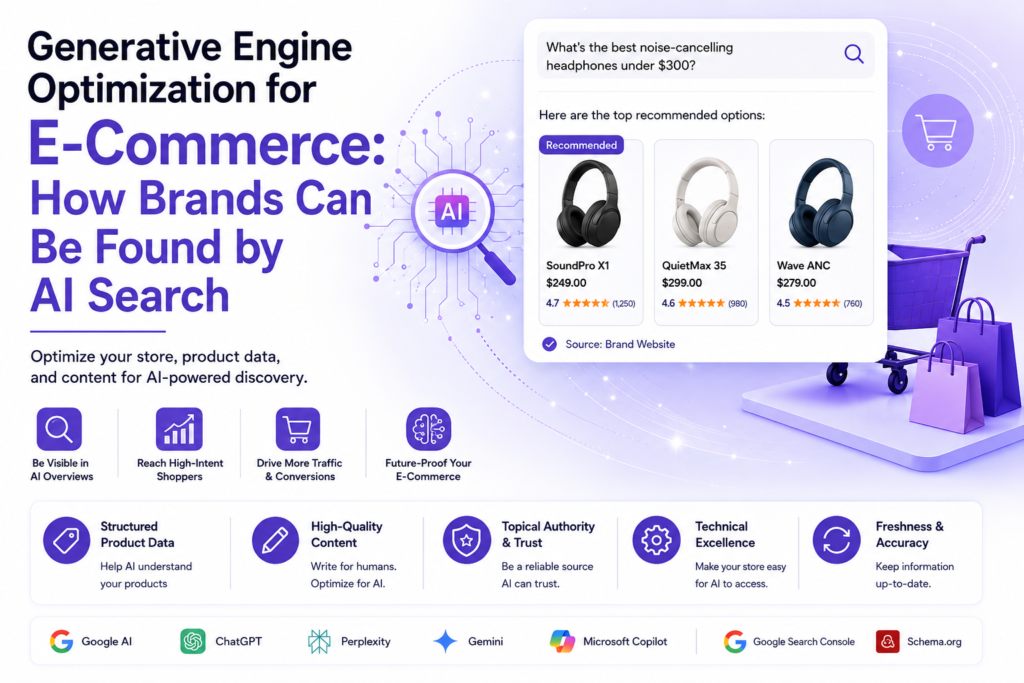
Generative engine optimization focuses on making useful content and product facts discoverable and understandable in AI search. Agentic commerce concerns the workflow that helps a shopper evaluate and potentially transact. Visibility work does not by itself implement purchasing.
Google’s AI search guidance says existing SEO fundamentals apply to AI Overviews and AI Mode, without special AI markup requirements. That guidance should not be confused with the separate requirements of an integrated checkout.
See our e-commerce GEO guide for search work and our AI commerce readiness checklist for a broader store audit.
A practical first pilot
Begin with a selected catalog and a comparison assistant that sends customers to the existing checkout. Define the questions it can answer and the evidence needed for each claim. This lets you evaluate usefulness before introducing payment actions.
If a transaction integration is justified, test it in a supported test environment. Include stale prices, unavailable variants, expired quotes, invalid destinations, payment failures and timeouts after order submission. Confirm that the assistant reports the actual outcome and preserves the shopper’s choices.
Measure performance against the current journey and include integration costs, latency and human support. Expand only when the pilot demonstrates useful results. There is no universal adoption deadline that requires every store to replace its checkout in 2026.
Frequently asked questions
Can AI shopping agents buy from any online store?
No. Purchasing depends on compatible tools, merchant support, payment capabilities and authorization. Product research may be available where integrated purchasing is not.
Does agentic commerce replace an e-commerce website?
No. The store still needs accurate product information, a reliable transaction system and post-purchase support. A website also provides a direct route for shoppers who prefer to browse or complete checkout themselves.
Do merchants need MCP or UCP?
Not universally. The appropriate interface depends on the channel and workflow. UCP is a commerce protocol; MCP is a tool integration protocol. Check the actual provider requirements before choosing either.
Will agentic commerce automatically improve sales?
No. Better comparison or reduced checkout friction may help, but inaccurate recommendations and transaction failures can add costs. Validate the effect with a controlled pilot and measured outcomes.
How CodeNdCoffee can support the foundations
CodeNdCoffee builds product data enrichment, supplier automation, marketplace integrations and commerce middleware. These systems provide the catalog and operational foundation for a supported shopping-agent workflow.
Start with the data or transaction problem that needs solving, then choose the integration around it. Discuss your agentic commerce integration requirements with CodeNdCoffee to scope a practical pilot.
Enjoyed this article?
Share it with your network