
Is Your Store Ready for the Shoppers Who Aren’t Human?
Assess your store’s AI commerce readiness: audit product facts, search access, offer consistency and integrations before expanding shopping automation.

- 9 Min Read
- Jun 4, 2026
- 215 Views
- What does AI commerce readiness cover?
- The three readiness gaps to audit
- What an AI-ready product record should contain
- A worked example: a delivery-sensitive product search
- An AI commerce readiness checklist for your team
- Connect the systems before expanding automation
- Measure readiness without claiming visibility you cannot see
- Frequently asked questions
- Where CodeNdCoffee can help
AI commerce readiness means giving shoppers and the systems assisting them accurate, accessible product information and a reliable path to purchase. It combines catalog quality, search visibility and operational consistency. It does not mean handing unrestricted control of your store to an AI agent.
For most of the last decade, running a good online store meant making it easier for a person to find you, trust you and buy from you. You polished product pages, improved checkout, made everything faster on mobile and worked on search rankings. That work still counts.
When an assistant helps someone compare products, another question becomes relevant: can it find enough reliable information to explain whether your product fits the request? A polished page can still leave material, sizing, availability or delivery details unclear.
This guide turns that question into a practical audit for e-commerce founders, operations teams and technical leaders. Start with the foundations you already need for customers, then evaluate any additional shopping integrations on their own requirements.
What does AI commerce readiness cover?
An AI-ready store makes important product facts understandable and keeps its published offers aligned with the systems that fulfill them. There is no universal certification or checklist that guarantees recommendations from every assistant.
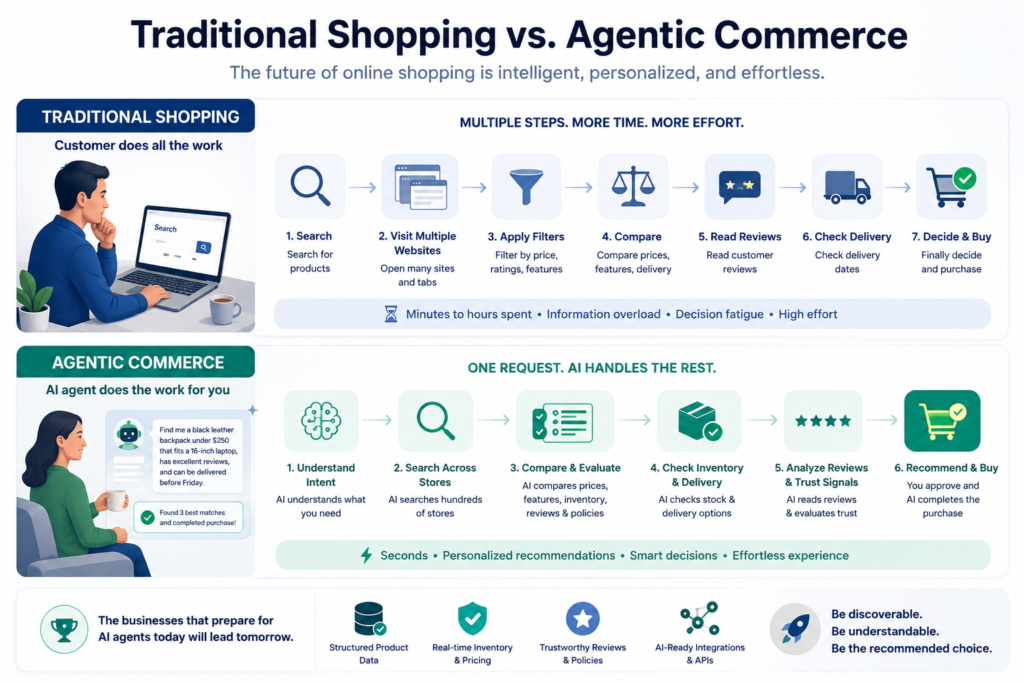
Separate three stages when planning improvements:
- Discovery: an assistant or search system finds product pages, buying guidance or supported catalog feeds.
- Comparison: it interprets attributes, price, availability and policies to help a shopper evaluate options.
- Transaction: a supported integration may help initiate a purchase. This requires separate authorization, current offer validation and a working checkout process.
A store can improve discovery without offering agent-operated checkout. Likewise, an internal assistant that handles operational tasks does not automatically make products discoverable. Our guide to AI agents for e-commerce operations covers that separate implementation question.
The three readiness gaps to audit
1. Catalog readiness: can someone compare what you sell?
Everything starts with the catalog. Inconsistent titles, missing attributes, vague sizing and unclear categories make comparisons difficult for customers and software alike. Check the details that matter to the buying decision rather than adding fields solely to make a record look complete.
Take a simple example: “Black Bag” leaves many questions unanswered. A useful record might identify the brand, product type, material, dimensions, closure, strap length and condition, alongside the relevant variant, price and availability. Only include details supported by supplier records or a verified product assessment.
In fashion, distinguish an item’s labeled size from its measurements and a retailer’s fit recommendation. For luxury resale, record condition and authenticity evidence through the approved review process. AI-generated copy should not invent material, provenance or certification.
AI product data enrichment can support attribute extraction, normalization and missing-field review. The output still needs source evidence and approval for uncertain claims.
2. AI visibility: can the information be found and understood?
Check whether product pages are accessible, internally linked and eligible for indexing. Important buying information should be available as text, with useful images supporting it. A missing citation in one assistant response is not proof that the page cannot be indexed.
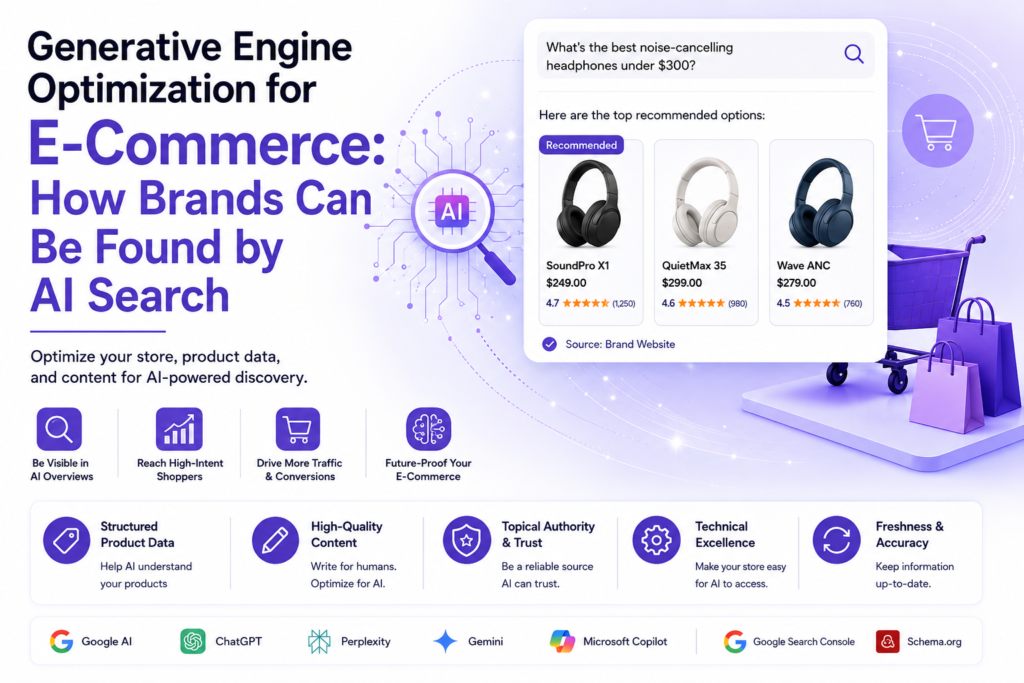
For Google’s AI Overviews and AI Mode, Google’s official AI search guidance says existing SEO fundamentals remain relevant. It does not require special AI markup or new machine-readable files. Eligibility does not guarantee that a page will appear.
Other shopping assistants and catalog integrations have their own access and data requirements. Avoid treating a recommendation observed in one system as a rule for all of them. Our e-commerce generative engine optimization guide explains content and visibility work in more detail.
3. Operational reliability: do offers match what you can deliver?
Good product content cannot compensate for a wrong price or unavailable variant. Staying reliable means keeping pricing, stock, delivery options and return information consistent across the store and its connected channels.
For many brands, the data lives across Shopify, an ERP, supplier spreadsheets, warehouse tools and marketplace feeds. Define which system owns each field, how updates travel and what happens when an update fails.
“Real time” is not a useful promise without a measured update interval and failure handling. A feed refreshed on a schedule should be described and monitored accordingly. Before an order is accepted, the transaction system must validate the current offer and availability.
Incorrect information can harm a purchase experience. There is no basis for claiming that every AI assistant learns from a failed purchase and permanently stops recommending the store.
What an AI-ready product record should contain
A product record should answer the questions a shopper needs resolved before buying. The exact fields depend on the category and sales channel.
- Identity: stable product and variant identifiers, brand, category and applicable manufacturer identifiers. Do not fabricate a GTIN for an item that lacks one.
- Specifications: verified material, dimensions, color, size and relevant compatibility or care details.
- Offer: variant-specific price, currency, availability and any applicable promotion terms.
- Delivery: destination coverage, shipping costs, handling times and the basis for delivery estimates.
- Policies: return eligibility, exclusions and a clear route to the full policy.
- Evidence: representative images, descriptive alt text and genuine reviews where available.
For US and European customers, avoid ambiguous currency and units. Keep translations and regional offers aligned with the version of the product actually available in that market. A delivery estimate for one destination should not appear as a universal promise.
Use structured data that reflects the visible page. Google’s product structured data documentation describes supported product search appearances. Structured data helps express product facts; it is not a guarantee of AI recommendations. Validate the appropriate markup and any channel feed separately.
A worked example: a delivery-sensitive product search
Consider this illustrative request:
“Find a black leather crossbody bag under $500 that can arrive before Friday.”
A title and photograph alone cannot establish whether the offer meets those constraints. The record needs verified material and product type, a price in the intended currency, the chosen variant’s availability and delivery information for the shopper’s location.
If the store only knows the dispatch date, it should not turn that into an arrival guarantee. If material is unverified, it should not label the product leather to match the query. Where information is missing, the right action is to fix or clarify the source record.
A readiness test can compare the product page, feed and checkout for the same variant and destination. Record disagreements and assign each one to the system or team responsible. This is useful even if the assistant never completes a transaction.
An AI commerce readiness checklist for your team
Start with a representative sample of products, including variants, low-stock items and products with different delivery or return conditions. Treat the following as an internal review framework, not an industry certification.
- Check access: verify intended product pages load, internal links work and indexing controls match your publishing decisions.
- Review product facts: list missing buying attributes and unsupported claims. Identify the evidence needed to resolve each one.
- Compare offers: check page, structured data, feed and checkout values for price, currency, variant and availability.
- Test regional policies: confirm shipping coverage, estimates and returns are clear for the relevant US or European destination.
- Trace updates: follow a controlled product or stock change through connected systems and record the propagation time.
- Test failures: check how stale feeds, unavailable variants, rejected updates and disconnected suppliers are detected and handled.
- Review assistant answers: use a small, repeatable set of buyer questions and record factual errors, sources and unanswered constraints.
Classify findings as a data issue, content issue, access issue or integration issue. Give each finding an owner and a way to verify its resolution. Prioritize incorrect offers and unsupported product claims before cosmetic content expansion.
Connect the systems before expanding automation
Marketplace operations offer a useful lesson: consistent identifiers, attribute mappings, feed validation and update monitoring make large catalogs manageable. A single-brand store can use the same discipline without becoming a marketplace.
E-commerce middleware development can connect product, supplier, warehouse and channel records while enforcing business rules. Build monitoring for rejected updates and reconciliation checks rather than assuming a successful API request means every channel is current.
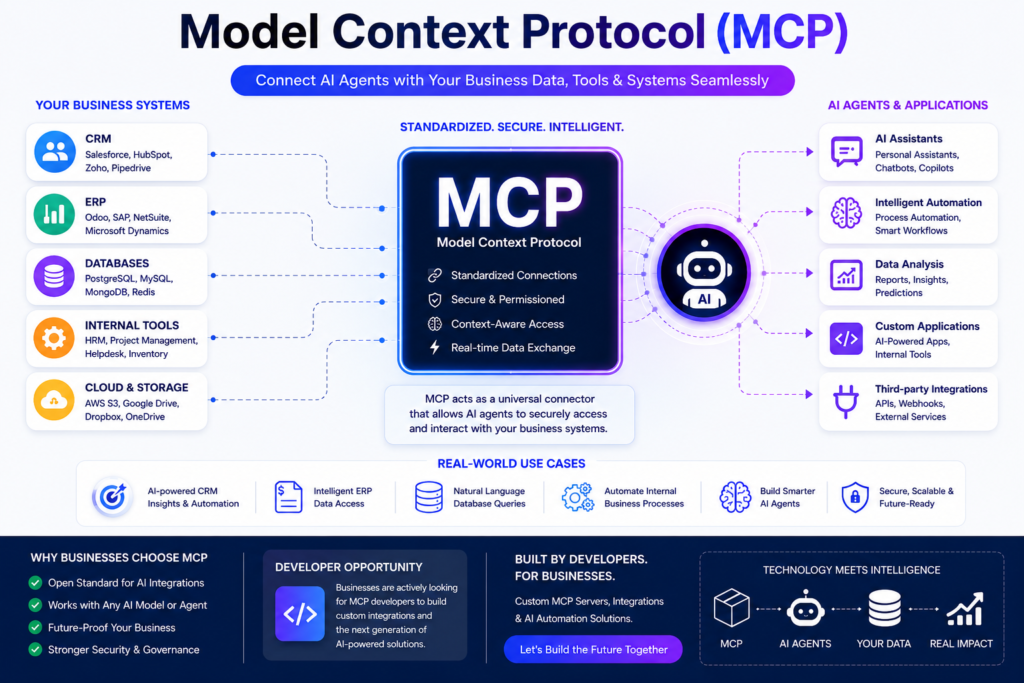
If you later expose tools to an assistant, begin with a bounded read-only task. Keep stock changes, purchase orders, refunds and customer data behind appropriate permissions. A read-only MCP inventory pilot illustrates one approach; MCP is an optional interface, not a prerequisite for shopping discovery.
Measure readiness without claiming visibility you cannot see
Some research may happen outside your site before a visitor arrives. Website analytics cannot reconstruct every assistant comparison or discarded recommendation. Referral data can also be incomplete.
Track operational measures alongside marketing outcomes:
- Missing required attributes and the proportion of sampled records with verified product facts.
- Price and availability mismatches between pages, feeds and checkout.
- Update delays, feed rejections and unresolved synchronization errors.
- Factual accuracy across a recorded set of assistant questions.
- Relevant referrals and conversions where attribution is available.
For manual assistant checks, record the date, question, region, system and cited sources. Repeat checks because answers can vary. A handful of prompts is a diagnostic sample, not a reliable estimate of total AI-search market share.
Use these results to find correctable gaps. Do not attribute a sales change to AI visibility without evidence that separates it from promotions, seasonality and other channel changes.
Frequently asked questions
Does my store need a chatbot to be ready for AI shoppers?
No. Accurate product records, accessible pages and consistent offers can support discovery without an on-site chatbot. A chatbot is a separate customer-service or shopping-interface decision.
Will product schema guarantee inclusion in AI shopping recommendations?
No. Structured data can communicate supported product facts, but it does not guarantee indexing, citations or recommendations. Keep it accurate and consistent with the visible offer.
Do I need APIs for AI shopping discovery?
Not universally. Discovery can involve indexed pages or supported feeds. A specific transaction or catalog integration may require APIs and must be assessed against its documented requirements.
What should an e-commerce team fix first?
Start with incorrect prices, availability and unsupported product claims. Then resolve missing buying attributes, unclear regional policies and access problems. Expand content or agent capabilities after these foundations are dependable.
Where CodeNdCoffee can help
AI readiness is a practical mix of catalog workflows, integrations, operational data and useful buying content. CodeNdCoffee develops product data enrichment systems, supplier automation, commerce middleware and marketplace integrations to support that foundation.
For content and technical search work, our e-commerce SEO and AI search optimization service complements those systems. Begin with one catalog or synchronization problem and define how success will be measured.
If your product pages, feeds and operational records disagree, discuss an e-commerce readiness review with CodeNdCoffee. The aim is a store that customers and connected systems can understand and use reliably.
Enjoyed this article?
Share it with your network