
Generative Engine Optimization for E-Commerce: How Brands Can Be Found by AI Search
A practical guide to e-commerce GEO: improve product facts, buying guidance, structured data and internal links, then measure AI search visibility without assuming guaranteed recommendations.

- 13 Min Read
- Jun 15, 2026
- 363 Views
- What is Generative Engine Optimization for e-commerce?
- Why GEO matters for e-commerce brands
- GEO does not replace SEO
- Product data is the foundation of e-commerce GEO
- Buying guides should explain product trade-offs
- Use structured data and product feeds accurately
- Support product claims with verifiable evidence
- Category pages should answer real buyer questions
- Connect buying guidance with relevant internal links
- Measure AI search visibility without mistaking it for ranking
- Common GEO mistakes e-commerce brands make
- A practical GEO implementation plan for e-commerce
- Where CodeNdCoffee can help
- Common questions about e-commerce GEO
Generative Engine Optimization for e-commerce is the practice of making product information and buying guidance easier to discover, verify and use in AI-generated search answers. It builds on technical SEO, accurate catalogs and helpful content; it does not guarantee that an assistant will cite or recommend your store.
A shopper may ask, “Which black leather handbag under $500 is suitable for everyday use?” rather than search for a product name. Your pages need to explain the relevant material, dimensions, price, availability and purchase conditions clearly enough to support that comparison.
This guide is for e-commerce founders, catalog teams and technical leaders deciding what to improve first. It covers product data, content, structured data, internal linking and a practical way to monitor AI search visibility.
What is Generative Engine Optimization for e-commerce?
Generative Engine Optimization (GEO) focuses on improving the discoverability and accuracy of information used in generated answers. For an online store, that information includes products, categories, specifications, reviews, pricing, availability and delivery policies.
SEO and GEO overlap. Search results, cited answers and shopping recommendations can draw on different sources, and each provider has its own systems. Google AI Overviews and AI Mode should not be treated as identical to every other assistant or shopping service.
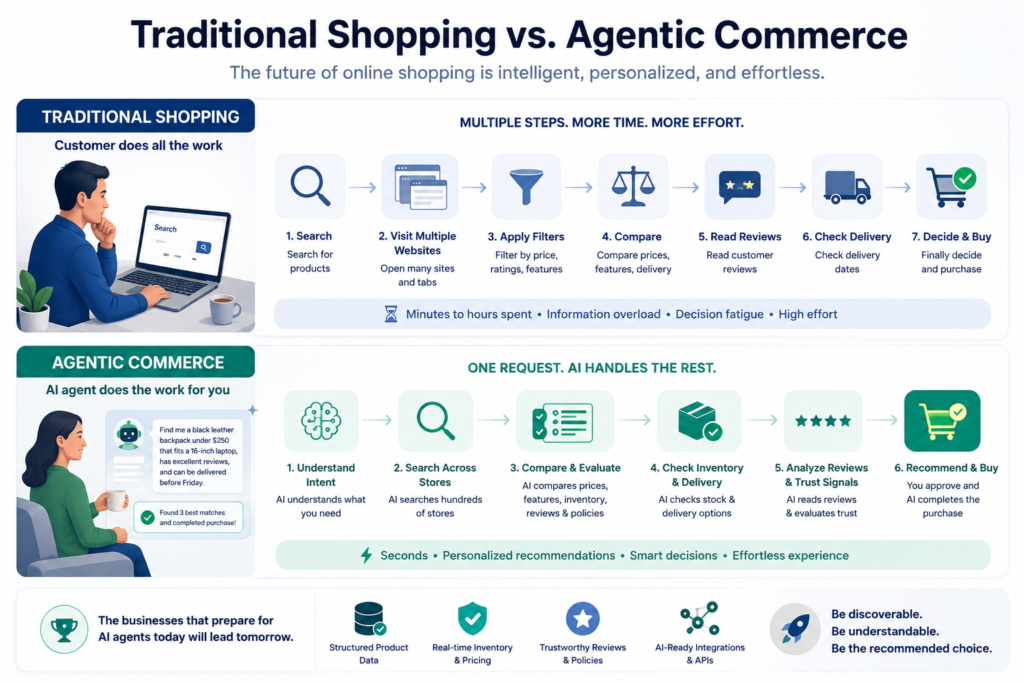
Answer Engine Optimization (AEO) is a related term for making content useful in direct answers. Agentic commerce concerns assistants participating in shopping workflows, potentially including transactions. This article focuses on discovery and information quality, rather than autonomous checkout.
Why GEO matters for e-commerce brands
An AI-generated comparison can introduce a shopper to a product before they visit its page. Missing specifications, contradictory stock information or unclear policies make that comparison less useful, regardless of how attractive the storefront looks.
The practical opportunity is to improve the information available to shoppers and search systems. Clearer product records, useful category guidance and consistent feeds also support onsite search and marketplace publishing. They are worthwhile improvements even when AI referral traffic is small.
Treat inclusion in an AI answer as a possible outcome, not a promised result. A mention does not necessarily produce a click, and a citation does not establish that your store will be selected for a purchase.
GEO does not replace SEO
GEO builds on SEO. Crawlable pages, helpful content, strong internal linking and a good user experience remain the foundation.
Google’s guidance on AI search features says existing SEO practices remain relevant. A page must be indexed and eligible to display a search snippet to qualify as a supporting link in AI Overviews or AI Mode. There is no special AI schema or new machine-readable file required.
For your store, check that important product and category pages are accessible without signing in, that canonical URLs identify the intended pages, and that accidental noindex or snippet restrictions are not blocking them. Review robots.txt and CDN restrictions before changing access settings; permissions for search crawling and model training are different decisions.
Product data is the foundation of e-commerce GEO
For e-commerce, GEO starts with product data.
Incomplete product data leaves buyers and search systems with fewer reliable facts for comparison. Do not assume that every provider calculates a shared “confidence score” for your store.
A strong product page should include more than a title, price, and image.
It should clearly explain what the product is, who it is for, what makes it different, how it compares, and why someone should choose it.
Important product data includes:
Product title, category, brand, price, availability, specifications, size, color, material, dimensions, features, benefits, use cases, reviews, FAQs, return policy, shipping details, images, alt text, schema markup, and related products.
For fashion e-commerce, this could mean including material, fit, occasion, size guide, color, style, season, condition, and care instructions.
For electronics, it could mean specifications, compatibility, warranty, battery life, dimensions, and comparison tables.
For furniture, it could mean measurements, material, room type, assembly details, delivery options, and care instructions.
Prioritize accurate attributes that answer purchase questions. More fields do not help if they are unsupported, contradictory or hidden from the systems that need them. Keep the source and review status for material, compatibility, condition and other consequential claims.
Example: make a product answerable
Consider the illustrative title “Black Bag.” A more useful record could identify the brand, shoulder-bag category, verified material, dimensions, strap length, condition, price and delivery region. Those details help answer a question such as “Will it fit a 13-inch laptop?” without guessing.
Only state that it fits a particular device if measurements or testing support the claim. For resale products, material, authenticity and condition should come from trusted records or specialist review. Our fashion product data enrichment guide explains how to combine supplier data, images and human validation.
For US and European storefronts, make currencies, size systems, delivery regions and applicable tax information clear for the market shown. Keep these details consistent across the visible page, structured data and product feeds.
Buying guides should explain product trade-offs
Buying guidance should answer the question behind the query.
A customer may not search for your exact product name. They may describe a problem or situation.
For example, “Which shoulder bag fits a laptop and works for a daily commute?” combines capacity, comfort and use case. A helpful guide explains how to compare those requirements, then links to products with verified measurements.
Helpful content can explain selection criteria that a product listing alone may not cover.
This is where buying guides, comparison pages, FAQs, blog posts, collection descriptions, and educational content become important.
A fashion guide could compare bag capacity, strap adjustment and care requirements. A furniture guide could compare chair dimensions and adjustment options. Explain who each option suits and where the evidence is limited, rather than producing interchangeable introductions for every category.
Lead with a direct answer, then explain the criteria, evidence and limitations. A handbag comparison could cover capacity, strap options, weight, material and care instead of repeating “premium quality.” Include original measurements or testing where available, and disclose when a recommendation is based only on supplier specifications.
Use structured data and product feeds accurately
Product structured data can describe offers, price, availability and eligible reviews. Google’s Product structured data documentation explains the supported product experiences and their requirements. Markup should match the information shoppers see.
- Use Product and Offer data on appropriate product pages, with the correct currency and availability.
- Include review or rating data only when it is genuine and meets the destination’s requirements.
- Use BreadcrumbList for navigation and Article or BlogPosting for editorial content, where appropriate.
- Keep merchant feeds synchronized with the storefront, especially after price or stock changes.
Google also recommends keeping Merchant Center information up to date. Validate representative product pages with the Rich Results Test and monitor relevant Search Console reports. Check that the selected variant, currency, price and availability agree across the page, markup and feed after an update. Structured data supports eligible search features; it is not a guarantee of an AI citation.
Helpful visible FAQs can answer purchase questions without special FAQ markup. Do not add FAQ or HowTo schema merely to pursue AI visibility or assume either will produce a Google rich result.
Support product claims with verifiable evidence
Buyers need evidence for the claims they use to compare products. Search systems also need accessible information, but the weight assigned to individual trust signals varies by provider.
For e-commerce brands, trust signals include customer reviews, product ratings, return policies, shipping information, warranty details, brand story, certifications, authenticity information, customer photos, and third-party mentions.
For luxury and vintage fashion, trust is even more important because buyers want confidence around condition, authenticity, product details, and return policies.
For AI search, vague claims are weak. Specific, verifiable information is stronger.
Instead of saying:
“High quality product”
For an illustrative product with verified specifications, it is better to explain:
“Made from full-grain leather, includes adjustable strap, fits a 13-inch laptop, and comes with a 30-day return policy.”
Specific details make your content more useful for both people and AI systems.
Publish genuine customer feedback and keep its meaning intact. Explain who prepared technical guidance and how claims were checked. Avoid inventing testimonials, certifications, sustainability claims or performance figures to make a page appear authoritative.
Category pages should answer real buyer questions
Many e-commerce stores treat category pages as simple product grids.
That is a missed opportunity.
Category pages can help buyers compare options when they explain the category clearly and answer common buying questions.
For example, a category page for “Women’s Leather Handbags” can include:
- What makes a good leather handbag?
- Which styles are best for daily use?
- What size should buyers choose?
- How should customers compare materials?
- Which colors are most versatile?
- How should customers care for leather bags?
This does not mean turning every category page into a long article. But it does mean adding useful context that helps AI systems understand the category and connect it to buyer intent.
A strong category page should combine product listings with helpful guidance.
For e-commerce GEO, category pages are important because customers often ask broad questions before choosing a specific product.
Connect buying guidance with relevant internal links
A product page should connect naturally to its category, relevant buying guidance, related products and purchase policies. Descriptive links make those paths easier for readers and crawlers to follow.
For example, a leather handbag guide could link to the handbag category, a material comparison, care instructions and suitable products. Link back from relevant category pages so the guide is discoverable through normal navigation.
When accurate information depends on several systems, content edits alone may not solve the problem. E-commerce middleware can coordinate approved product data, inventory and channel-specific transformations. This is the operational layer that helps keep pages and feeds consistent.
Use a link because it answers the reader’s next question. Repeating the same keyword anchor or adding unrelated links does not make an article more useful.
Measure AI search visibility without mistaking it for ranking
Start with questions your customers actually ask, such as “Which leather handbag fits a laptop?” or “Where can I buy pre-owned designer bags with delivery to Germany?” Build a small, repeatable query set rather than testing unrelated prompts.
- Record the test conditions: provider, date, language, market, signed-in state, whether web search was enabled and the exact question.
- Review the answer: note brand mentions, cited URLs, factual errors and whether the suggested product is relevant.
- Repeat over time: answers vary by session and model. Use a consistent test method and record how many responses were checked. One response is an observation, not a stable ranking.
- Compare with business data: review identifiable referral visits, engagement and purchases. Some journeys will not be attributable to an AI mention.
- Fix source errors: correct outdated pages or feeds and document the change before the next test.
Google reports traffic from AI Overviews and AI Mode within overall Web search performance in Search Console, as explained in its AI-feature measurement guidance. Do not present ordinary organic clicks as a separately measured AI traffic total.
Common GEO mistakes e-commerce brands make
Many e-commerce brands will try to optimize for AI search, but some will approach it the wrong way.
One common mistake is creating generic AI-written content. If every page sounds the same and does not provide real product value, it will not build trust.
Another mistake is focusing only on blog posts while ignoring product data. For e-commerce, the product catalog is the core asset. Missing product facts cannot be repaired by publishing more blog posts.
A third mistake is ignoring technical SEO or assuming that schema can compensate for inaccessible pages.
Another mistake is making exaggerated claims. AI systems and customers both need accurate information. This is especially important for health, beauty, luxury, supplements, electronics, and financial products.
Finally, many brands forget consistency. If your product information is different on your website, marketplace listings, social profiles, and review platforms, AI systems may struggle to understand which information is correct.
Keep facts consistent while allowing useful differences in presentation. A marketplace title can differ from a storefront title; the material, variant, price and availability must still describe the same offer and market.
A practical GEO implementation plan for e-commerce
Begin with one commercially important category and a manageable set of product pages. Our recommendation is to establish a baseline before making changes:
- Audit access and indexing. Check representative URLs, canonical tags, snippet controls and crawl restrictions in Search Console.
- Audit product completeness. Record missing attributes, stale stock, pricing discrepancies and unanswered purchase questions.
- Repair the source data. Assign trusted sources and owners to each field. Use enrichment to propose missing information, with review for uncertain attributes.
- Improve the visible pages. Add concise answers, useful comparisons, descriptive internal links and supporting evidence. Preserve information that already helps buyers.
- Validate publishing. Check that approved values reach the storefront, schema and merchant feeds. Test price and stock updates.
- Review outcomes. Repeat the query set and compare data accuracy, search performance and qualified visits. Expand only after the workflow is maintainable.
Assign an owner to source data, publishing checks and content updates. Keep a change log so the next review can distinguish a corrected product fact from a change in the answer provider. Our AI product data enrichment service covers workflows for completing catalog attributes with source evidence and human review.
The AI commerce readiness guide provides broader context on catalog and operational preparation.
Where CodeNdCoffee can help
GEO for e-commerce often crosses content, technical SEO and catalog operations. CodeNdCoffee builds product-data enrichment, supplier automation, marketplace integrations and middleware that connect these workflows.
Our A Retro Tale commerce operations case study illustrates connected catalog and publishing work. It is operational context, not evidence of a measured increase in AI search citations.
If your store has incomplete product information, disconnected feeds or unclear buying guidance, explore our Ecommerce SEO & AI Search Optimization service. Start with a category audit and an agreed set of data-quality and visibility measures.
Common questions about e-commerce GEO
Does GEO replace traditional SEO?
No. GEO overlaps with SEO and focuses attention on how information is used in generated answers. Crawlability, indexing, clear content and relevant internal links remain necessary foundations.
Can schema guarantee a product recommendation?
No. Accurate markup can support eligible search features, but there is no schema type that guarantees an AI recommendation. The visible product information must remain accurate and useful.
Should you create separate pages for every AI prompt?
No. Cover related buyer questions on useful product, category and guide pages. Publish a new page when it serves a distinct need, rather than producing near-duplicate content for prompt variations.
What should an e-commerce team improve first?
Check whether important pages can be discovered, then fix missing product facts, inconsistent prices and stock, and unclear purchase policies. Measure a defined set of queries before expanding the work.
Enjoyed this article?
Share it with your network