
Supplier Product Data Onboarding With AI for Luxury Fashion
A practical supplier data onboarding workflow for luxury fashion: preserve source records, validate AI suggestions, review sensitive details and publish reliable listings.

- 8 Min Read
- Oct 20, 2026
- 9 Views
A supplier sends a spreadsheet with product names, a folder of images and an invoice. None of them quite agree. The catalog team still has to decide which record represents each item, which attributes can be trusted and what is safe to publish. For luxury fashion and resale, that work is especially consequential: a wrong material, model or condition can travel from the product page into marketplace feeds and customer support.
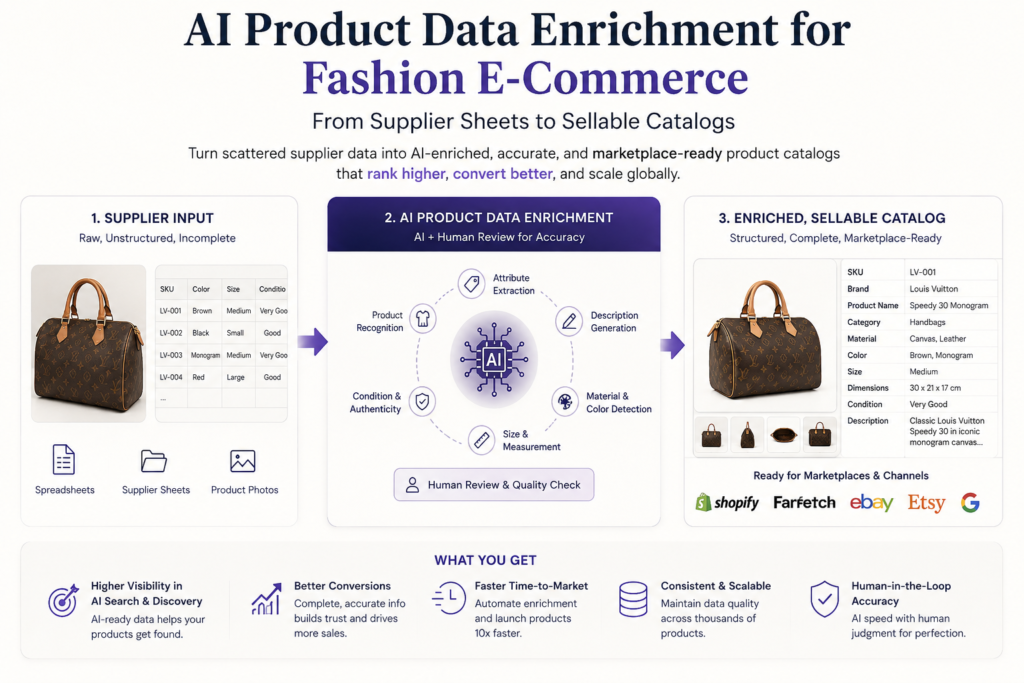
Supplier product data onboarding is the process of turning those incoming sources into a traceable, reviewed product record. AI can help extract and suggest information, but the useful outcome is a dependable workflow—not a longer AI-generated description. This guide focuses on the steps between receiving supplier data and approving a listing for commerce channels. For the wider picture, see our guide to AI product data enrichment for fashion e-commerce.
Why luxury fashion supplier data needs its own workflow
Supplier files are rarely shaped like a finished catalog. One source may use a supplier reference, another a brand style code, and a third only a short description. Images arrive separately. Sizes may follow different regional systems. A resale item adds an individual condition and inspection history that cannot simply be copied from a standard product record.
The immediate risk is not just a blank field. It is a confident-looking field with no clear source. If an AI tool infers a leather type from a photograph or copies a previous item’s condition, the listing may look complete while the underlying evidence is weak. A good intake process keeps the original evidence, the proposed value and the approval decision separate.
Supplier product data onboarding: a six-step workflow
1. Capture the source before cleaning it
Keep the original invoice, purchase order, spreadsheet, image set or API payload. Record when it arrived, who supplied it and the supplier’s reference. Then create an intake record for each candidate product. This gives the team a way to trace a published attribute back to its source if a discrepancy appears later.
Do not overwrite source values as you standardize them. A supplier’s “navy” may become your catalog’s “dark blue,” but both values are useful: one for reconciliation, the other for consistent filtering and channel feeds.
2. Establish product identity and variant relationships
Before generating descriptions, decide what the item actually is. Match supplier references, brand or model identifiers, purchase documents and images. Separate the product family from a sellable variant—such as a particular size or color—and from an individual pre-owned item where relevant. Flag possible duplicates rather than silently merging them.
This is where a small identity mistake creates large downstream problems. Two sizes merged into one SKU can break availability. One resale item duplicated across channels can create an avoidable stock conflict. The identity check should happen before enrichment or publication.
3. Map data into a category-specific schema
Define required fields by category and channel. A handbag may need dimensions and hardware details; footwear needs a usable size and size system; a watch needs different model and specification fields. Separate fields that describe the product from fields that describe a particular item, such as its inspected condition.
A practical record can include: source reference, internal product ID, category, brand, model or style, variant, material, color, size, images, condition where applicable, price, and approval status. Add only fields your teams and channels actually use. For external distribution, check the destination’s current rules; for example, Google Merchant Center’s product data specification sets attribute requirements that vary by product type, market and program.
4. Use AI for extraction and proposals, with evidence attached
AI can read semi-structured documents, propose a category, standardize a color term, identify visible features and prepare a draft title. Those are useful suggestions when each value has a source and a review path. A field extracted from an invoice should be distinguishable from a field inferred from an image or generated from catalog conventions.
For luxury goods, leave unverified facts blank or mark them for review. An image may suggest a material or model, but it does not establish authenticity. Condition should follow an inspection process, not an image-only guess. The same principle applies to price: a recommendation can support a decision, but it should not silently become the approved selling price.
5. Review by risk, not by a single confidence score
Route uncertain or commercially sensitive values to the people who can verify them. A catalog editor might approve title wording and taxonomy. A trained specialist may need to confirm a model, condition description or authenticity-related statement. Show reviewers the source image or document beside the proposed value, and record what they changed.
Rules are often clearer than one overall score. For example: a missing size blocks footwear publication; a category suggestion can be approved in a catalog queue; an unsupported authenticity claim is never auto-published. These are workflow design examples, not universal thresholds. Each business should set its own approval rules around its inventory and obligations.
6. Validate for each destination and close the feedback loop
An approved internal record is not automatically ready for every destination. Centra, Shopify, a marketplace and a product feed may require different field names, category mappings, image rules or variant structures. Validate the output for each channel before sending it. Keep publication status and error messages connected to the original product record so a rejected item returns to the right queue.
This is where e-commerce middleware becomes useful: it can translate one governed product record into channel-specific formats and keep stock and publication events visible to operations. It should not turn an unverified source field into an approved fact.
What this looks like for one incoming item
Consider an illustrative resale handbag. The invoice says “black leather bag” and gives a supplier reference. The photos show a shoulder strap and metal hardware, but the model name and leather type are absent. The intake record preserves the invoice reference and attaches the images. AI proposes a bag category and a draft title. It leaves the model, material subtype, condition and authenticity status unresolved. A specialist inspects the item, confirms supported details and approves the final record. Only then is it mapped to the storefront and applicable marketplaces.
The point is not that every field requires manual work. It is that the system can move routine preparation forward while making uncertainty visible. A missing fact is easier to resolve than an invented one that has already reached customers.
Build the controls around the real handoffs
Start with a short set of questions that your intake team can answer:
- Which source is authoritative when an invoice, supplier file and image disagree?
- Which fields can be standardized automatically, and which require inspection?
- What makes an item ready for catalog review, channel validation and publication?
- Who resolves duplicates, missing references and rejected listings?
- Can a reviewer see the source and change history for a disputed field?
These decisions matter more than choosing an AI model first. They also make it easier to introduce automation gradually: begin with one supplier feed or category, measure the exceptions, then expand the rules that prove reliable.
Measure quality after publication, not just speed at intake
Useful operational measures include the share of records that pass first review, time from receipt to approved listing, number of fields corrected by reviewers, duplicate or unmatched-item rate, and channel rejection rate. Track corrections after publication as well. A faster intake queue is not progress if teams spend the saved time repairing inaccurate listings.
Reliable source attributes also make it easier for search and shopping systems to interpret a product. Our article on generative engine optimization for e-commerce looks at the discovery side; supplier intake addresses the data those systems receive.
For a real example of connected supplier intake, AI-assisted preparation, specialist review and multi-channel publishing, see the A Retro Tale luxury resale operations case study. It shows why enrichment works best as part of an operational system rather than an isolated content tool.
Where to start
Choose one category with a manageable volume and collect a sample of recent supplier files, images and final listings. Mark every field that required interpretation, correction or a second source. From that evidence, define your first schema and review rules. Automate extraction and normalization where the source is clear, then test the workflow against the records that previously caused trouble.
If supplier intake currently depends on spreadsheets and repeated manual entry, our AI product data enrichment work can help connect extraction, review and publishing to the wider commerce operation. The aim is a catalog your team can explain and maintain—not simply a faster way to fill fields.
Enjoyed this article?
Share it with your network