


Supplier intake and validation
Collect supplier feeds, spreadsheets and documents, then flag missing references, quantities or required fields.
Custom ecommerce operations automation for supplier intake, product approvals, inventory exceptions and channel workflows.
We design controlled workflows for the work between your commerce systems: receiving supplier information, applying business rules, routing exceptions to the right person and moving approved records to the next step.
Collect supplier feeds, spreadsheets and documents, then flag missing references, quantities or required fields.
Route products, prices and channel-ready records to the right reviewer before publication.
Surface stock discrepancies and stalled updates for investigation rather than leaving them hidden.
Coordinate follow-up tasks when orders, shipments or returns need a human decision.
Track failed steps, retries and reconciliation so teams can restore the expected state.
Give teams clear queues, status views and decision history across the workflow.
Ecommerce operations automation connects the steps between supplier intake, product preparation, approvals, inventory, orders and sales channels. CodeNdCoffee builds these workflows around the systems your team already uses, with clear rules for what runs automatically and what needs human review.
A reliable workflow does more than move data. It records where a product or order came from, checks required fields, assigns the next action and exposes failures before they become silent operational problems.
We start with a specific process and its exceptions rather than automating every task at once. A supplier onboarding flow might receive a spreadsheet or invoice, match it to an incoming-goods record, check identifiers and quantities, route missing information to a catalog specialist, and pass an approved record to the commerce platform. The exact steps depend on your systems and business rules.
Ecommerce middleware handles reliable connections and data movement between platforms. AI product data enrichment extracts and improves catalog information. Operations automation coordinates the wider process: when work starts, which rules apply, who reviews an exception and when an approved result moves forward. A project may use all three, but they solve different parts of the problem.
We recommend starting with a measurable bottleneck, such as supplier intake or a recurring exception queue. Document the current handling time and error patterns before changing the workflow. The resulting system should make decisions traceable, preserve manual override when needed and give your team a way to recover from failures.
Our A Retro Tale luxury resale case study shows how supplier intake, catalog preparation, marketplace publishing and other commerce operations can work within one connected platform. If your team is copying data between systems or losing track of approvals, tell us which workflow is slowing you down; we can help scope an approach around your existing stack.
Our Ecommerce Operations Automation Services delivery process combines discovery, solution architecture, implementation, integrations, quality assurance, deployment, and ongoing optimization. Every phase is aligned with your business goals, existing technology, and measurable outcomes.
We assess your goals, users, workflows, existing systems, technical constraints, and success criteria before defining the project scope.
We map the user experience, data flows, integrations, platform structure, and delivery roadmap needed for a reliable solution.
Our team builds or configures the solution in clear milestones, connecting the APIs, platforms, data, and tools your operation depends on.
We validate functionality, integrations, accessibility, security, and performance across realistic workflows before release.
We prepare staging and production environments, manage migration and launch, configure monitoring, and provide practical documentation.
After launch, we monitor reliability, resolve issues, deliver updates, and improve the system using operational feedback and performance data.
See how our Ecommerce Operations Automation work turns business requirements into dependable, production-ready digital systems.
Each featured project connects product strategy, user experience, engineering, platform integrations, quality assurance, and post-launch optimization to clear operational goals.
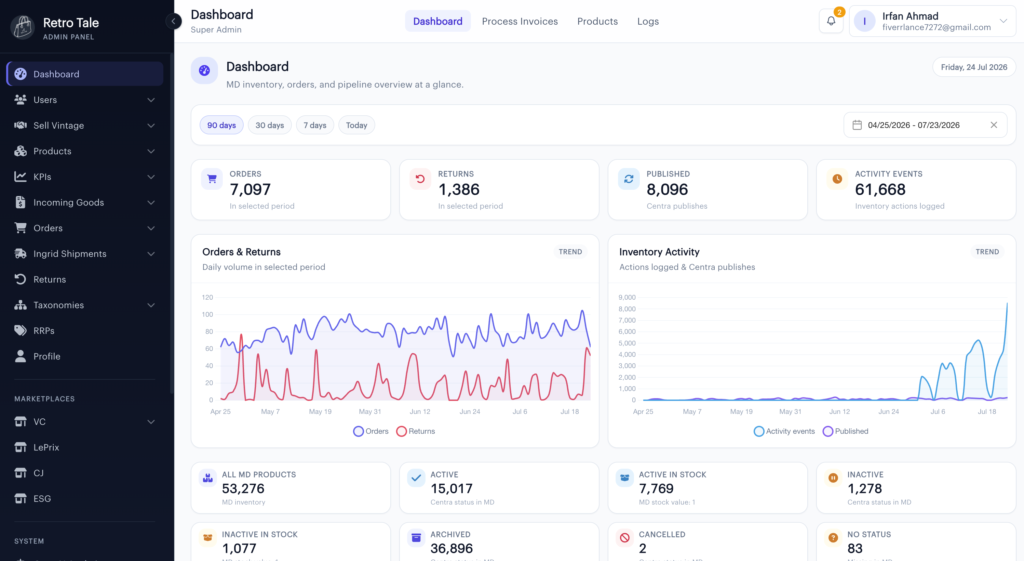
A connected operational platform for luxury fashion resale, bringing supplier invoices, inventory, product data, marketplace workflows, orders, shipments and reporting into one workspace.
From strategy and custom development to integrations, automation and long-term support, explore related services that can strengthen the next stage of your project.
See All ServicesAutomate product data enrichment for Shopify, Shopify Plus, Centra and ecommerce catalogs with AI-powered attributes, content, categories and descriptions.
Learn more Custom SaaS & Business PlatformsCustom CRM and ERP-style platforms for ecommerce operations and real estate workflows, built around your data, teams, integrations and decisions.
Learn moreBook a partnership call and we'll map the right approach, responsibilities, timeline, and next steps for your project.
Common questions about Ecommerce Operations Automation, from planning to ongoing operations.
Often, yes. We first map the available APIs, files, webhooks and data ownership across your commerce platform, ERP, PIM, WMS and marketplaces. Some systems allow event-driven updates; others need scheduled transfers or manual checkpoints. We recommend the integration approach after reviewing platform limits, data quality and failure handling.
No. Approval rules should reflect the risk of each decision. Routine, well-defined changes can proceed automatically when required fields and business rules pass. Missing data, conflicting supplier information, low-confidence product attributes or sensitive pricing changes can be routed to a named reviewer. We agree those thresholds with your team before implementation.
Middleware connects platforms and moves data reliably between them. Operations automation defines what should happen around that movement: validation, routing, approvals, exception handling and recovery. A supplier record, for example, may be transferred through middleware but still need review before publication.
We usually start with a defined bottleneck such as supplier intake, product approval, inventory exceptions, order handoffs or marketplace publishing. The workflow is designed around your existing systems, business rules and the decisions your team needs to retain. We scope the specific steps after mapping how work is handled today.
The workflow should make the failure visible, retain enough context to investigate it and avoid silently skipping a record. Depending on the system, we can use validation, safe retries, alerts, a human exception queue and reconciliation checks. The recovery path is designed around the business impact of that step; not every failure should be retried automatically.

CODENDCOFFEE LLC


640-G, Block R 1 Phase 2 Johar Town, Lahore, 54782
Copyright © 2026 CodendCoffee. All rights reserved.