


Reduce manual handling
Replace repeated exports, imports and copy-paste workflows with controlled automation.
Connect ecommerce platforms, business systems and sales channels through custom middleware designed around your product, inventory, order, fulfillment and operational workflows.
Web · Mobile · Headless
Products · Inventory · Orders · Returns
Ecommerce businesses often rely on separate systems for product data, inventory, orders, fulfilment, payments and marketplaces. When those systems do not communicate reliably, teams fall back on spreadsheets, manual imports and fragile scripts.
CodeNdCoffee builds custom ecommerce middleware that centralises integrations, applies business rules and keeps operational data moving between the platforms your teams already use.
Replace repeated exports, imports and copy-paste workflows with controlled automation.
Keep products, inventory, orders and fulfilment statuses aligned across systems.
Process growing product and order volumes without increasing repetitive workload.
Use logs, retries, alerts and review queues instead of silent integration failures.
Every integration is designed around your data ownership, workflow rules, platform constraints and operational priorities.
Synchronise products, variants, attributes, pricing, media and categories between commerce platforms and backend systems.
Keep stock levels aligned across ERP, warehouses, storefronts, marketplaces and physical locations.
Automate validation, routing, warehouse submission, fulfilment updates and shipment tracking.
Coordinate listings, channel attributes, prices, inventory, orders and shipment updates.
Connect return requests, warehouse receipt, restocking decisions, refunds and customer notifications.
Process product data from APIs, spreadsheets, feeds, invoices, documents and product images.
We design integrations around each platform’s APIs, webhooks, data models, rate limits and operational requirements instead of relying on one-size-fits-all connectors.
Our ecommerce work includes supplier intake, product enrichment, Centra publishing, marketplace distribution, inventory, orders, shipments, returns and operational reporting.
Prebuilt connectors work well when the source and destination systems follow a predictable process. They become limiting when a business has custom requirements, unusual product structures or multiple systems sharing responsibility for the same data.
Instead of adapting your operations to the limitations of a standard connector, custom ecommerce middleware can be designed around the way your business actually works.
For middleware projects, we identify data ownership, integration dependencies, failure scenarios and operational controls before defining the architecture and building the integration layer.
We begin by understanding the systems, data ownership, current movement of information and operational friction inside your ecommerce workflow.
We document key entities, map how they differ between platforms and define the transformation rules each integration requires.
We select the right architecture based on business requirements, platform limitations, data volume and reliability needs.
We encode the rules that determine how product, inventory, order and operational data should be processed.
Each integration is built and tested against realistic workflows so expected and unexpected scenarios are handled properly.
Reliable middleware should make integration problems visible, traceable and recoverable for the teams responsible for operations.
After launch, we can support platform changes, performance improvements, new channels and evolving business rules.
Synchronize product catalogs, prices, inventory and orders across ecommerce stores and marketplaces.
Manage complex variants, supplier data, product imagery, attributes, collections and seasonal catalog workflows.
Coordinate supplier intake, product enrichment, condition data, inventory, customer offers, marketplaces, shipments and returns.
Connect customer-specific pricing, account data, product availability, ERP records, orders and invoicing.
Normalize incoming supplier data and publish consistent product records across ecommerce channels.
Replace fragile scripts and manual work with integrations designed to support greater catalog and order volume.
Middleware and product data enrichment solve related but different problems. Together, they can create a more automated ecommerce catalog workflow from supplier intake to channel publishing.
AI product data enrichment improves product records by generating, extracting or standardizing information such as attributes, titles, descriptions, categories and tags.
Ecommerce middleware manages how that information moves between suppliers, internal systems, ecommerce platforms and marketplaces.
Middleware must do more than move data under ideal conditions. It must handle the failures and inconsistencies that occur in real ecommerce operations.
Long-running and high-volume tasks can be processed asynchronously without blocking operational users or storefront activity.
Temporary platform or API failures can be retried automatically, while persistent errors are recorded for review.
Where appropriate, integrations are designed to prevent duplicate records when an event or job is processed more than once.
External ecommerce and marketplace APIs often restrict request volume. Middleware can schedule and throttle work accordingly.
Product, inventory and order information can be validated before it reaches the destination system.
Teams can track when records changed, which system initiated the change and whether synchronization succeeded.
Operational teams can see how ecommerce data moves between platforms, where issues occur and which workflows need attention.
Middleware can help define trusted systems of record for products, inventory, orders and customer data across connected ecommerce operations.
Individual platform connectors can be maintained or replaced without rebuilding the entire middleware platform.
See how our Custom eCommerce Middleware Development Services work turns business requirements into dependable, production-ready ecommerce systems.
Each featured project connects solution architecture, workflow automation, platform integrations, quality assurance and post-launch optimization to clear operational goals.
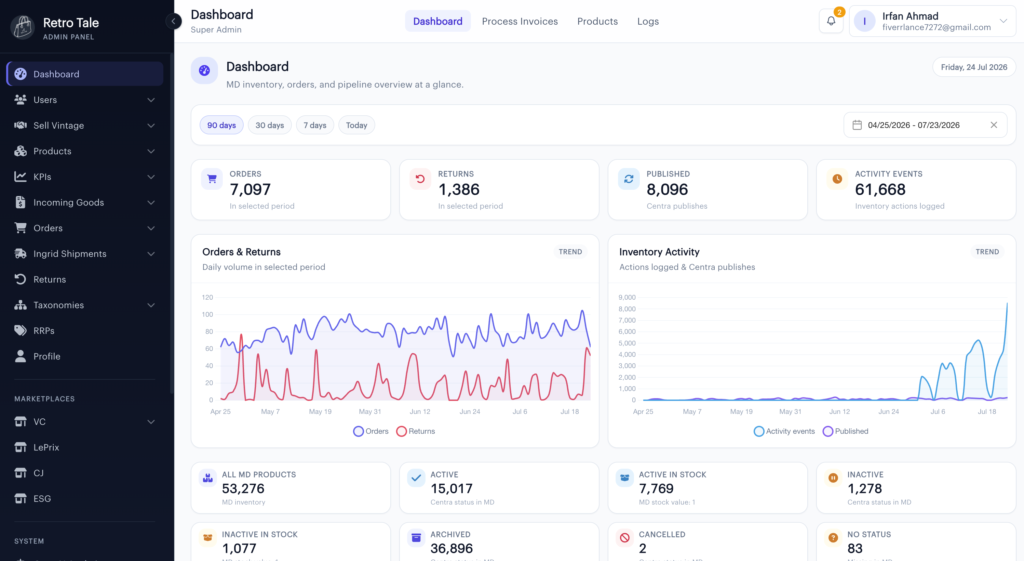
A custom SaaS back-office platform that centralizes inventory, product publishing, marketplace operations, orders, shipments, and analytics for a luxury vintage resale business. It helps internal teams process products faster, reduce manual work, and manage multi-channel ecommerce operations from one system.
From intelligent data enrichment to seamless integrations, we offer the expertise to power every part of your ecommerce journey.
See All ServicesImprove ecommerce catalog quality with AI-assisted product attributes, titles, descriptions, categories and review-ready product data.
Learn more Related ServiceMaintenance and support services that keep applications secure, optimized, and reliable through monitoring, updates, bug fixes, and ongoing technical assistance.
Learn moreWe build ecommerce middleware around real operations, not only API documentation. Our work connects systems, teams, product data, order flows and long-term platform changes into maintainable software.
Discuss Your Ecommerce IntegrationReplace fragmented integrations and repetitive manual work with a middleware platform designed around your ecommerce operations.
Whether you need to connect Shopify, Shopify Plus, Centra, BigCommerce, WooCommerce or a headless ecommerce system with ERP, PIM, WMS, marketplaces or internal software, CodeNdCoffee can design and develop the integration layer your business needs.
Answers about ecommerce integrations, ERP sync, marketplaces, headless systems, failed jobs and middleware versus plugins.
Ecommerce middleware is software that connects an ecommerce platform with other systems such as ERP, PIM, WMS, marketplaces, payment providers, shipping services and internal applications. It manages data transformation, synchronization, business rules and workflow coordination between those systems.
Yes. We can develop middleware to synchronize products, prices, inventory, customers, orders, fulfillment and returns between Shopify or Shopify Plus and an ERP system.
Yes. We develop custom systems and integrations around Centra, including product publishing, inventory, orders, supplier workflows, marketplaces, fulfillment and custom back-office operations.
Yes. Middleware can provide a shared operational layer across multiple ecommerce stores, brands, regions or platforms, depending on how products, inventory and orders should be managed.
Yes. We can build integrations for product feeds, marketplace categories, attributes, prices, inventory, orders, shipments and listing-error management.
Yes. We build middleware for headless and composable ecommerce architectures involving custom storefronts, commerce APIs, CMS platforms, search services, PIM, ERP and other backend systems.
We can implement logging, automatic retries, failed-job queues, alerts, synchronization histories and administrative controls for reviewing and reprocessing failed records.
No. A plugin generally operates inside one ecommerce platform and solves a defined integration problem. Middleware is an independent layer that can connect multiple platforms, centralize business rules and coordinate more complex workflows.

CODENDCOFFEE LLC


640-G, Block R 1 Phase 2 Johar Town, Lahore, 54782
Copyright © 2026 CodendCoffee. All rights reserved.