

The Operational Software Behind Modern Clinic Management
More Than a Scheduling Tool
Every patient journey moves through intake, scheduling, procedure preparation, document signing, treatment, payment, follow-up, and reporting. Generic admin dashboards and disconnected EMR add-ons were not designed for this level of operational and compliance complexity.
The Challenge
Clinics were running on spreadsheets, separate payment portals, email-based document flows, and tools that did not share a common patient record. Teams needed one platform built around real clinic workflows — not another isolated module.
Custom Healthcare SaaS
A dedicated clinic operations platform built around real practice workflows with HIPAA-aligned security by design.
Rather than becoming another scheduling add-on, the platform became the operational engine powering patients, procedures, documents, payments, and engagement across every location.
Scaling clinic operations across locations, providers, and compliance
Medical practices face operational challenges that generic business software is not always designed to handle.
Fragmented patient and procedure data
Patient profiles, procedure history, and clinical documents lived across multiple tools with no single source of truth for staff or administrators.
Scheduling built for time slots, not clinical capacity
Clinics needed procedure-aware calendars with location rules, availability constraints, blackout dates, and capacity limits — not a generic appointment grid.
Limited lifecycle visibility
Teams needed a clear view of every patient between intake, booking, document signing, treatment, payment, refund, and follow-up.
Disconnected payments and documents
Payment processing, consent forms, and treatment documents had to work as connected workflows rather than separate links, emails, and manual reconciliation steps.
Compliance and access control gaps
PHI had to move through the system with role-based access, audit trails, encryption, and HIPAA-aligned safeguards — not ad hoc permissions across disconnected apps.
From patient intake to treatment, payment, and follow-up
Every patient follows a structured path through the practice, with clear handoffs between staff, systems, and external services.
This connected healthcare workflow helps clinic teams manage patient data, scheduling, documents, payments, and engagement from one reliable operational platform.
A Smart Clinic Platform Built Around Real Practice Operations
Instead of disconnected modules, Regrow was built as one connected operational ecosystem where patients, procedures, documents, payments, and engagement work together in a single workflow.
Major connected modules across the Regrow platform
One shared operational system connects patient management, scheduling, documents, payments, engagement, and administration.
Authentication & Access
Secure login with email verification, password management, Google and Microsoft SSO, and session controls.
Role & Permission Management
Dynamic RBAC with granular permissions, custom roles, and route-level access control for staff and administrators.
Patient Management
Create, search, filter, and manage patient profiles with multi-location assignment and complete history tracking.
Patient Portal
Dedicated patient login for viewing appointments, procedures, documents, and transaction history.
Procedure Management
Track procedure types, groups, statuses, attachments, and audit history at the patient and location level.
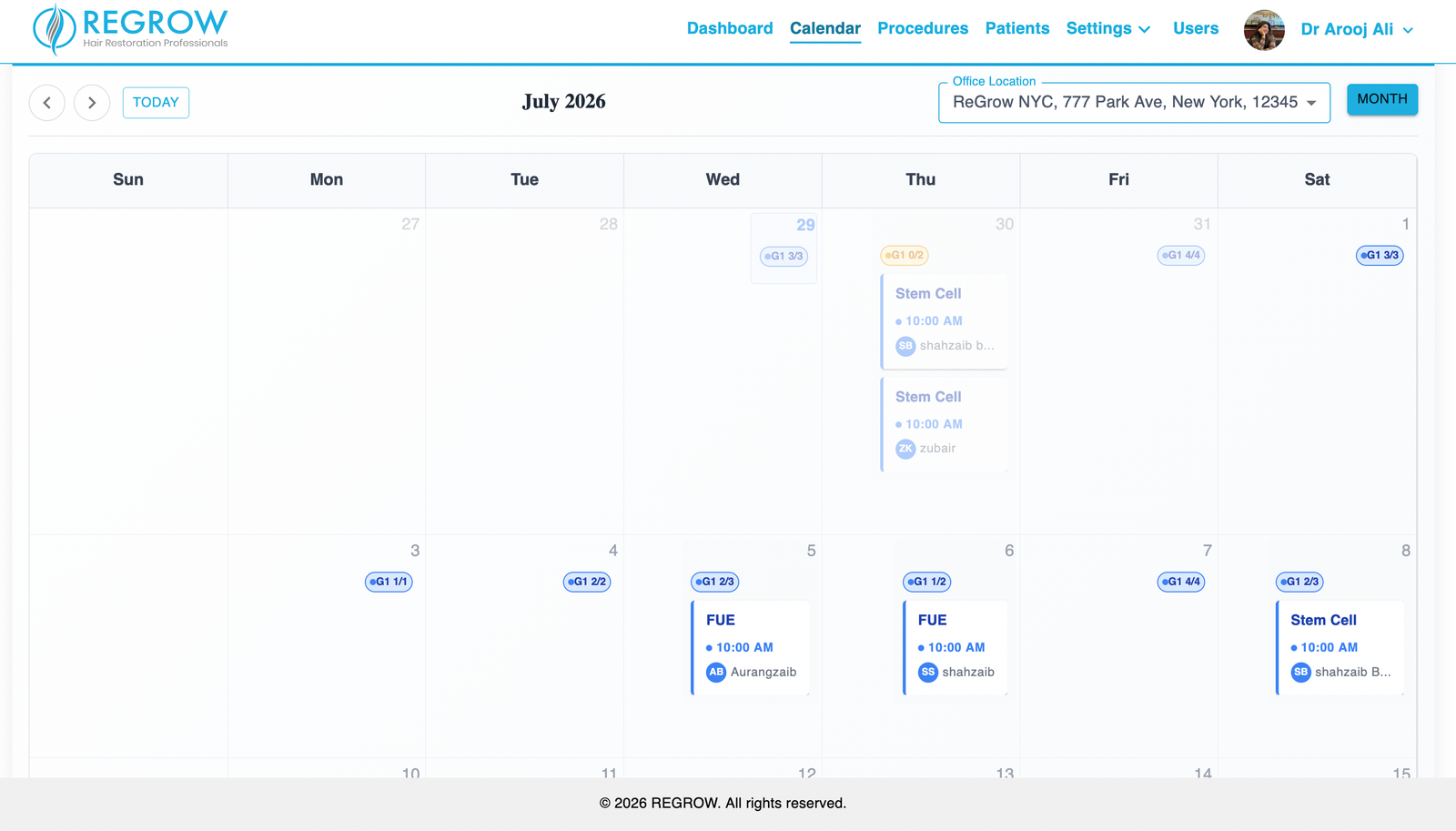
Procedure-Aware Calendar
FullCalendar-based scheduling with drag-and-drop, per-location settings, availability rules, and blackout dates.
Document Management
Organize patient and procedure documents with categories, types, preview, download, and version history.
PandaDoc E-Signature
Generate consent and treatment documents from templates, pre-fill PHI, and track signature status through completion.
Payment Processing
Authorize.net integration for cards and eCheck with refunds, saved methods, and encrypted credential storage.
Transaction Dashboard
Filter, search, export, and review revenue activity with real-time payment status and reporting views.
Business & Location Management
Configure business profiles, multiple locations, and location-specific calendar and operational settings.
GoHighLevel Integration
Sync patients to GHL contacts, trigger pipelines and campaigns, and keep engagement connected to clinical activity.
User Management
Manage staff accounts, role assignment, profile settings, and operational ownership across the practice.
History & Audit Logs
Maintain history for critical entities so teams can trace changes across patients, procedures, and documents.
Security & Compliance Layer
PHI-scoped data model, encrypted sensitive fields, least-privilege access, and HIPAA-aligned operational controls.
Patient Management
Central patient records with multi-location assignment and complete history tracking.
Payment Processing
Authorize.net integration with encrypted credentials, refunds, and transaction reporting.
PandaDoc Integration
Consent and treatment document automation with e-signature and signed PDF storage.
GoHighLevel Engagement
Patient sync, pipeline triggers, and recall campaigns connected to clinical activity.
15+
Connected Platform Modules
Each module is designed around a specific clinical or operational area, but all share the same patient, procedure, and payment data — so nothing gets lost between systems.
Applying security where it protects patients and practice operations
Security is embedded into selected workflows instead of being treated as a standalone checkbox. It reduces compliance risk while keeping staff workflows fast and usable.
Role-based by design
Staff access only what their role allows; administrators control permissions at a granular level.
Identity & access
JWT authentication, Google and Microsoft SSO, session timeout, and cross-tab session sync.
Authorization
Dynamic roles, permissions, middleware protection, and patient portal access separation.
Data protection
Encrypted payment credentials, PHI-scoped models, and secure document handling.
Operational traceability
History logging for patients, procedures, documents, and payment activity.
Payment security
PCI-aware Authorize.net integration with encrypted storage and controlled refund flows.
Infrastructure posture
Serverless AWS Lambda architecture with environment-based configuration and scalable isolation.
Important: In healthcare, weak access control or fragmented PHI handling can impact trust, compliance, and day-to-day operations. Regrow prepares structured clinical workflows while enforcing security and auditability at every handoff.
Connecting the systems behind the practice
The platform acts as an operational hub where clinical workflows, payments, marketing automation, and document signing work together through one controlled system.
4+
Connected Systems
1
Central Platform
Real-time
Data Flow
Internal operations platform
Manages patients, procedures, scheduling, documents, payments, users, and reporting.
Authorize.net
Payment gateway — Processes cards and eCheck, supports refunds, and stores encrypted gateway credentials.
GoHighLevel (GHL)
Marketing automation — Syncs patients to contacts, triggers pipelines, and supports recall and reactivation workflows.
PandaDoc
Document automation — Generates consent and treatment documents, pre-fills PHI, and returns signed PDFs to patient records.
OAuth providers
Google & Microsoft SSO — Enables secure single sign-on for staff and simplified account access.
Reporting layer
Custom dashboards — Operational and payment data is transformed into filterable views, exports, and management insight.
A clearer, faster and more scalable clinic operation
Regrow gives practices one operational environment for managing the processes behind patient care, scheduling, documentation, and revenue.
Live operational core
One platform. Full clinic loop. Zero tool sprawl.
Patient intake, procedure scheduling, clinical documents, e-signature, payments, and engagement now move through a single HIPAA-aligned system.
- Intake Patient capture
- Schedule Procedure calendar
- Document Clinical records
- Secure Core HIPAA-aligned
- Sign PandaDoc flow
- Pay Authorize.net
- Engage GoHighLevel
Faster scheduling operations
Procedure-aware calendars, availability rules, and blackout management reduce scheduling friction across locations.
Better patient visibility
History, documents, and procedure records make incomplete or delayed cases easier to catch.
Consistent clinical records
Shared patient and procedure structure keeps documentation aligned across staff and sites.
Connected revenue workflows
Payments and refunds sit beside patient and procedure data — not in a separate system.
Structured consent flow
PandaDoc links templates, e-signature, and signed storage to the patient journey.
Decision-ready reporting
Review payment activity and operational history without stitching tools together by hand.
Built to keep evolving
New gateways, SMS reminders, analytics, EHR integrations, and mobile access can extend the serverless architecture without creating disconnected tools or extra operational noise.
Inside the healthcare platform
Important screens are presented alongside the business workflow they support, making the case study easier to scan.
Regrow Scheduling View
Drag-and-drop procedure calendar with location-aware availability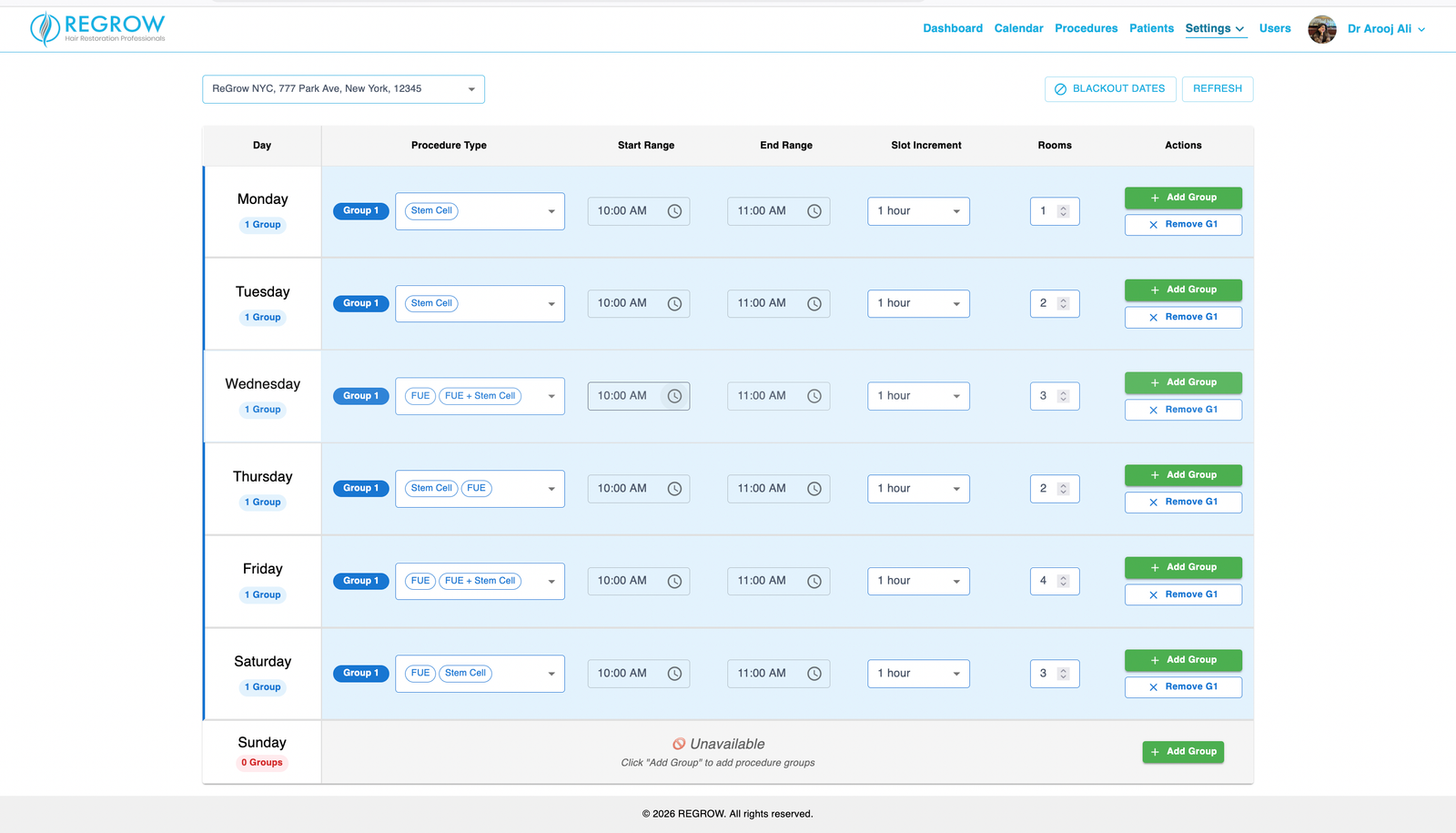
Regrow Calendar Settings
Procedure groups, availability windows, slots and room capacity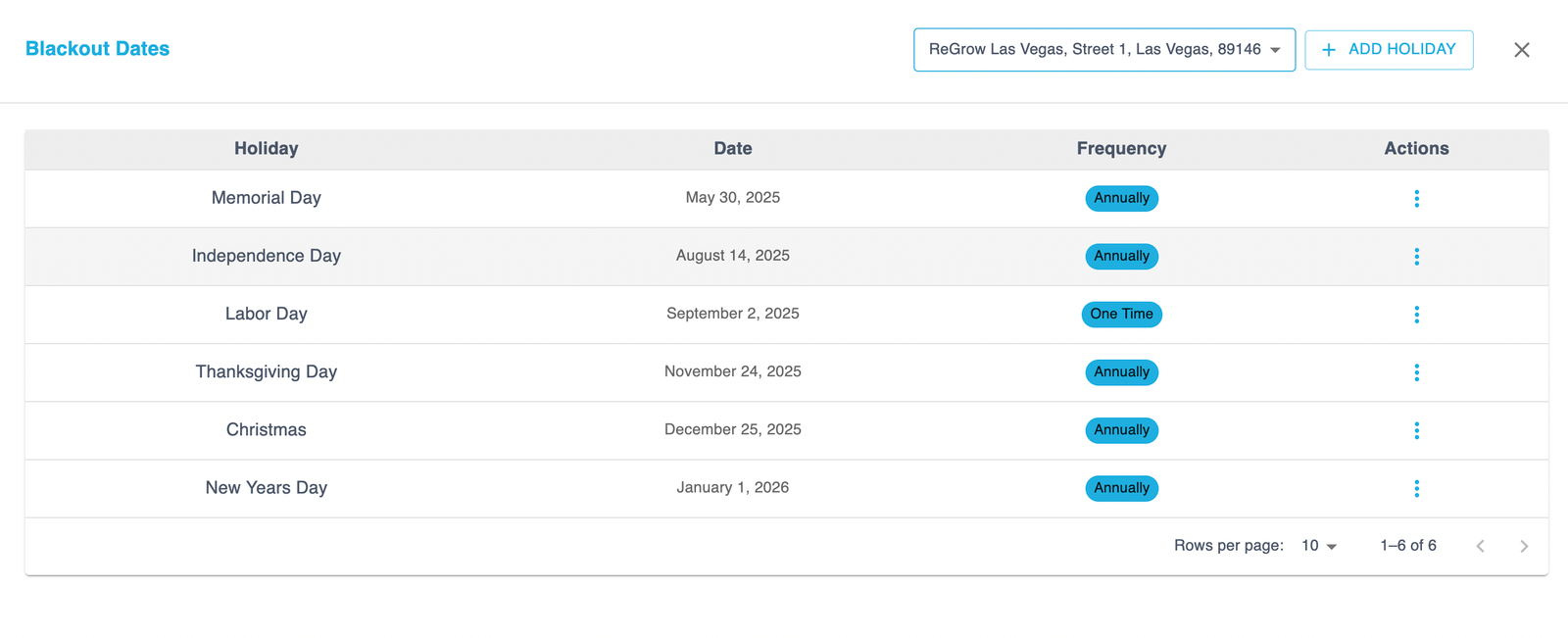
Regrow Blackout Dates
Holiday and unavailable date controls per practice location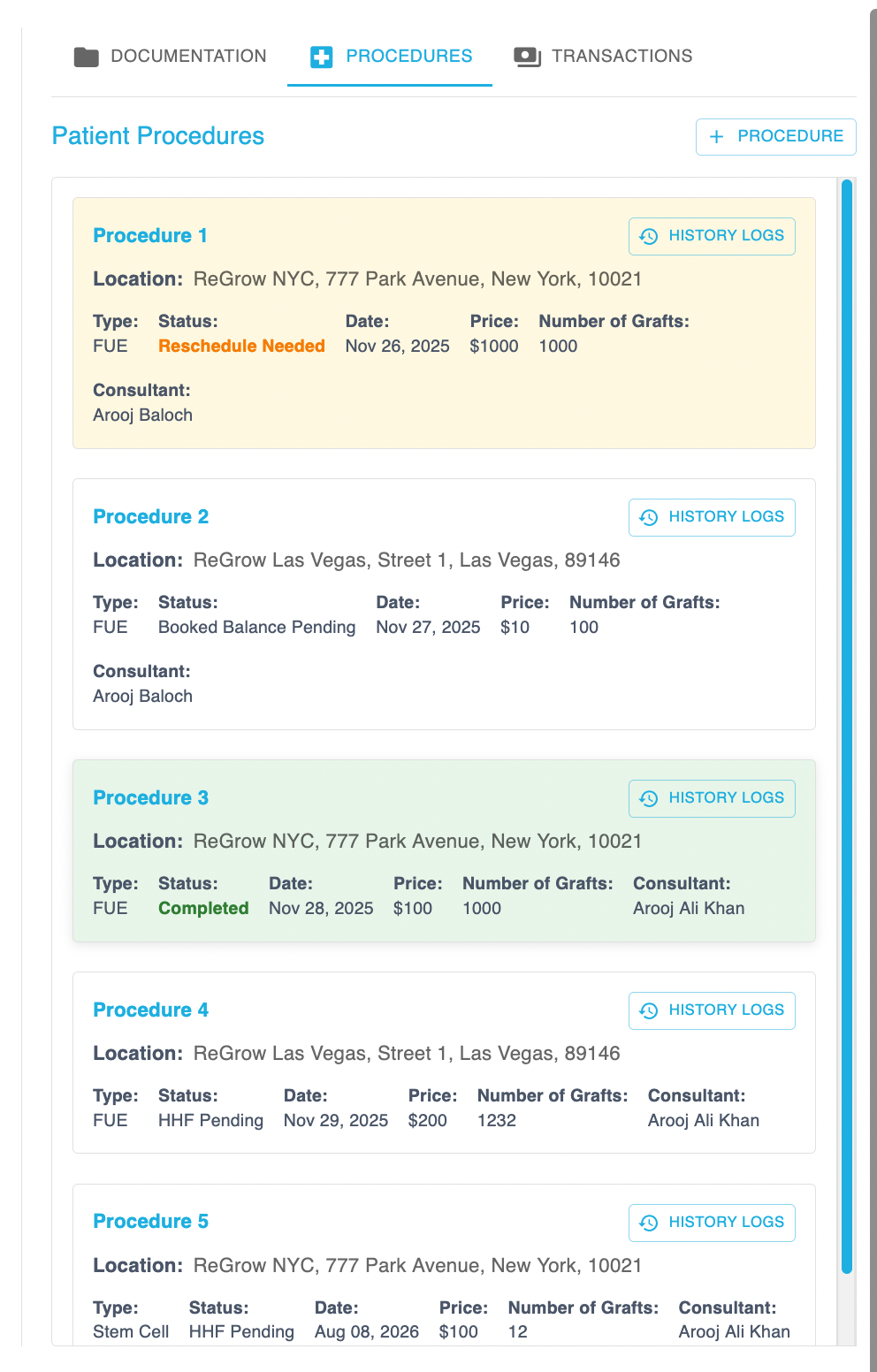
Regrow Patient Procedures
Procedure status, pricing, grafts and consultant tracking per patient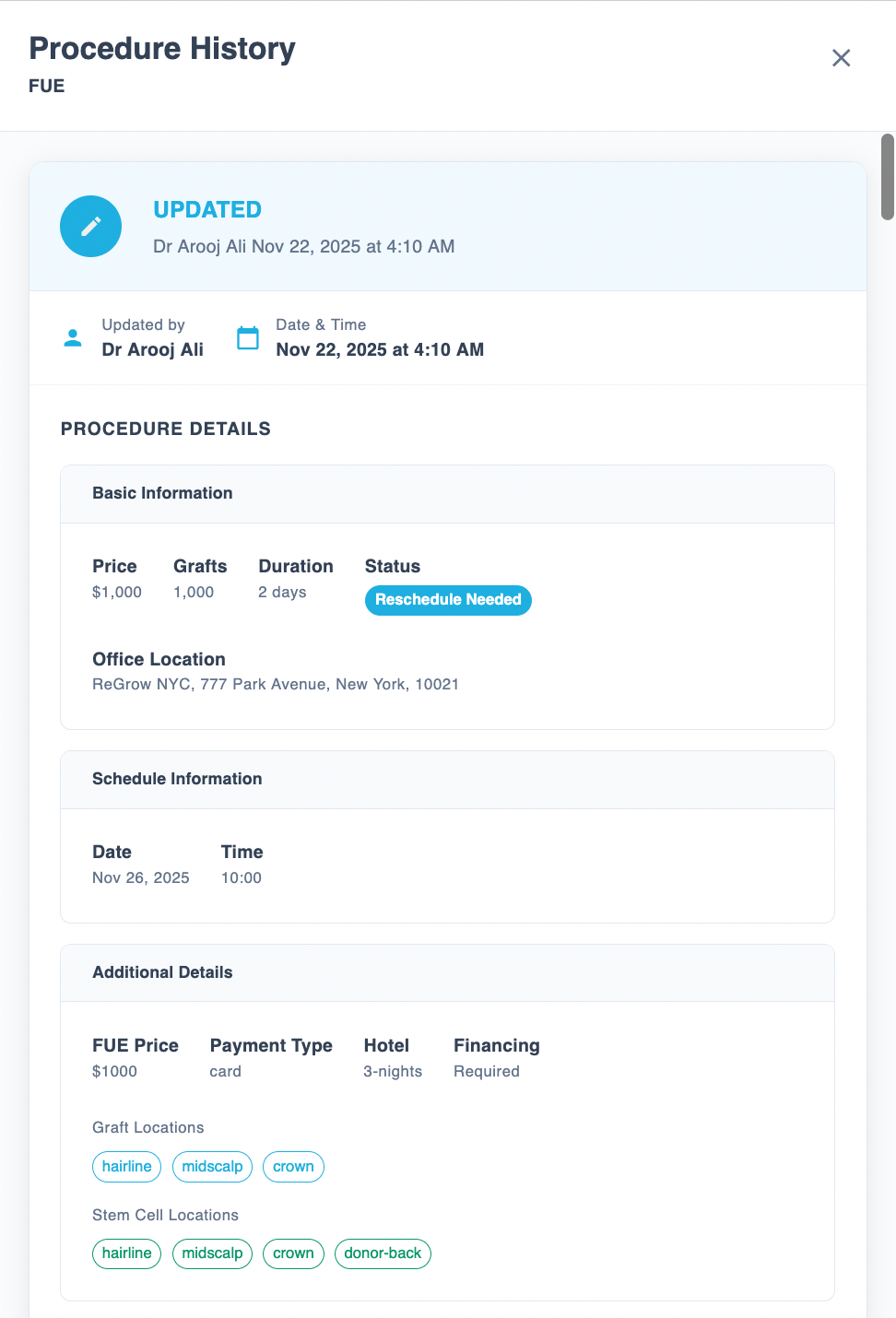
Regrow History Logs
Audit trail for procedure updates, schedule and clinical detailsBuilt for long-term healthcare operations
The platform was developed using technologies selected for maintainability, security, integrations, and ongoing product development.
Node.js
BackendReact 18 + Vite + MUI
FrontendFullCalendar
SchedulingMongoDB
DatabaseAuthorize.net
PaymentsGoHighLevel
EngagementPandaDoc
DocumentsJWT/OAuth
AuthenticationRBAC/AES-256
SecurityAWS Lambda
InfrastructureAPIs
IntegrationsReporting
Analytics
Regrow's operations continue to evolve as practices introduce new locations, procedure types, payment requirements, engagement workflows, and compliance needs.
CodeNdCoffee works as a long-term engineering partner rather than treating the platform as a one-time delivery. New capabilities are designed within the existing serverless architecture so the system can evolve without creating disconnected tools or unnecessary operational complexity.