
Model Context Protocol (MCP) for E-commerce Integrations
A practical guide to Model Context Protocol for e-commerce teams: how MCP works with APIs and middleware, useful workflows, security boundaries, and a measured rollout.

- 9 Min Read
- Jun 29, 2026
- 300 Views
- What Is Model Context Protocol?
- Why Traditional AI Integrations Become Hard to Maintain
- How MCP Works
- MCP vs APIs and E-commerce Middleware
- Practical E-commerce Use Cases
- MCP and AI Agents: Access Is Only One Part
- Security and Data Boundaries
- Preparing Your Business for MCP
- How CodeNdCoffee Can Help
Model Context Protocol (MCP) gives AI applications a standard way to access external data and tools. For an e-commerce team, that could mean asking an assistant to investigate excess inventory, explain failed marketplace listings, or prepare product-data changes for review.
Your ERP manages inventory. Your e-commerce platform manages orders. Supplier files and product records may live elsewhere. MCP can make selected capabilities from these systems available to a compatible AI assistant, but the integrations, permissions, and data quality still need engineering.
This guide explains how MCP works, where it fits alongside APIs and commerce middleware, and how to evaluate a useful first implementation.
What Is Model Context Protocol?
Model Context Protocol is an open protocol for connecting AI applications to external tools, data sources, and reusable prompts. It standardizes how those capabilities are exposed and accessed; it does not train a model on your business or automatically connect every application you use.
Think of it as a common interface between an AI application and business software. A compatible AI application can use an MCP server without requiring a separate integration interface for every assistant. The host still decides which capabilities reach the model and how results are used. You still need to check the capabilities and protocol versions supported by each client and server.
Why Traditional AI Integrations Become Hard to Maintain
Many companies begin their AI journey with isolated automation projects. A chatbot connects to the website. An AI assistant reads documents from cloud storage. A reporting tool generates weekly summaries.
However, as more AI tools are introduced, integration becomes increasingly difficult. Teams may repeat work to describe the same operations, validate inputs, and connect different assistants to the same backend systems.
MCP can reduce that repeated interface work. It does not remove the underlying differences in APIs, authentication, permissions, or data structures. A maintained MCP server is another software component with its own testing, monitoring, and support requirements.
How MCP Works
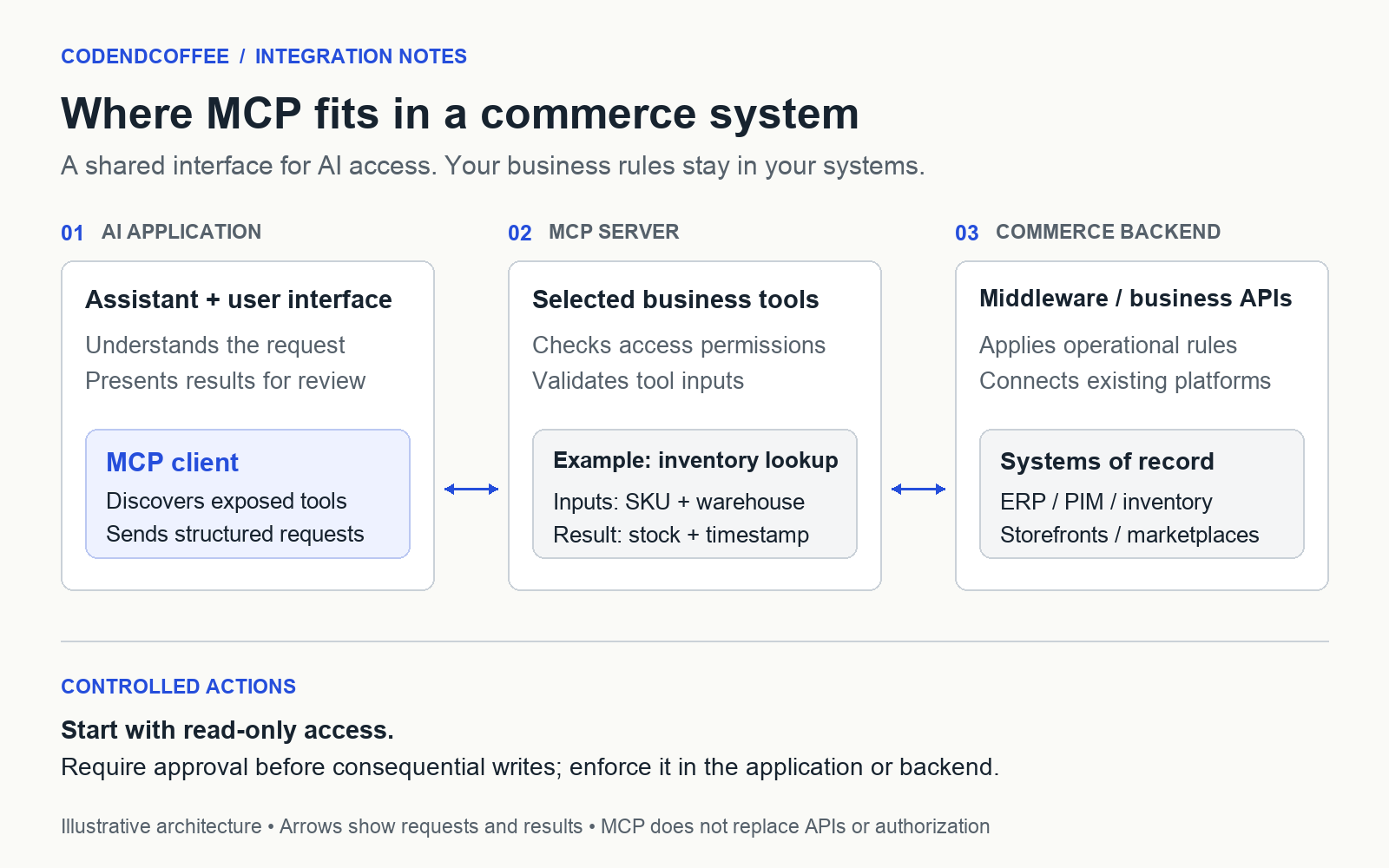
The official MCP architecture separates three roles:
- Host: the AI application the user interacts with.
- Client: the component inside that application that communicates with an MCP server; a host can manage multiple clients for different servers.
- Server: the program exposing selected business capabilities to the client.
Servers can offer tools that run operations, resources that supply context, and prompts that provide reusable interaction templates. For example, an inventory lookup could be a tool, a catalog field guide a resource, and an inventory-review checklist a prompt. These are illustrative designs, not built-in commerce features. See the MCP server concepts for the distinctions.
A typical commerce request follows this path:
- The user asks a question in natural language.
- The host makes capabilities from configured MCP servers available to the assistant.
- The assistant requests an appropriate tool with structured inputs, such as a date range and warehouse identifier.
- The server checks permissions and inputs, then calls the relevant business service or API.
- The host receives the result, and the assistant presents an answer with source references and limitations.
MCP does not independently discover every system in your company. Your team configures the connections and decides which operations to expose. Servers can run locally through standard input/output (stdio) or remotely through Streamable HTTP. Select a transport and authentication approach supported by the intended host, and test client/server compatibility before rollout.
MCP vs APIs and E-commerce Middleware
MCP usually sits above existing APIs and middleware. These layers serve different purposes:
- APIs expose a platform’s data and operations, such as retrieving an order or updating a product.
- Commerce middleware coordinates mappings, validation, synchronization, retries, and business rules across systems.
- MCP gives compatible AI applications a common way to discover and request selected capabilities.
For example, an MCP tool could request the status of a marketplace listing through your middleware. The middleware remains responsible for channel-specific rules and reliable synchronization. Our e-commerce middleware development services cover that operational integration layer.
Use MCP when conversational access or reuse across compatible assistants has a clear benefit. For a fixed stock-sync process or scheduled export, a direct API integration, webhook, or background job may be simpler. MCP also does not replace document retrieval: a search service can be exposed through an MCP tool when an assistant needs supporting documents.
Practical E-commerce Use Cases
The following are proposed workflows, not claims about deployed MCP projects or measured client results.
Investigate Declining Sales and Growing Inventory
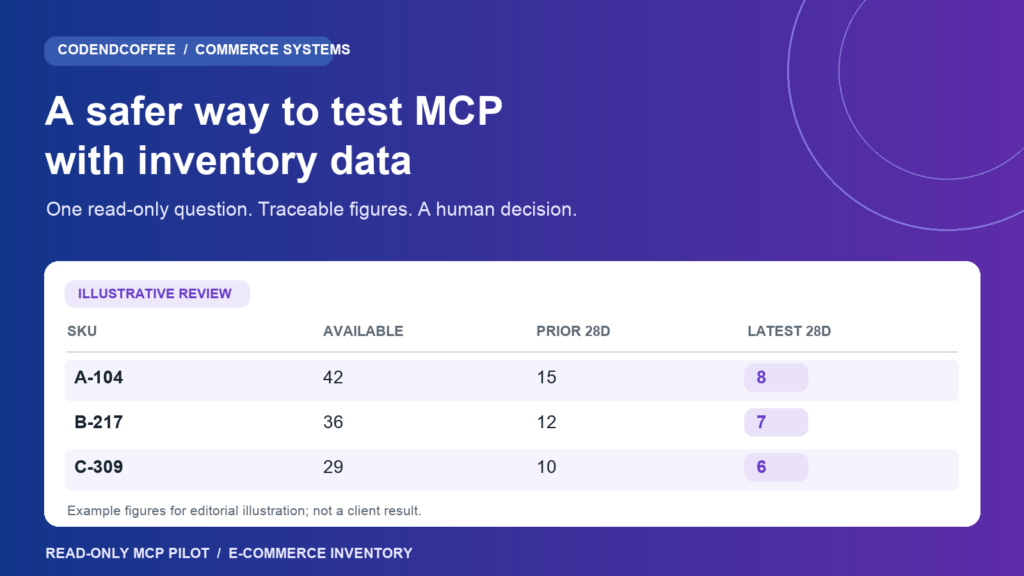
Imagine an e-commerce business. The owner asks: “Which products have declining sales but increasing inventory?”
A read-only tool could compare sales and inventory snapshots using agreed definitions. Before building it, specify whether sales means units or revenue, how returns are treated, which warehouses count, and which periods are comparable.
Return SKU-level figures, source timestamps, and any missing data alongside the summary. Distinguish available-to-sell stock from physical stock, reservations and incoming purchase orders so the assistant does not treat them as interchangeable. Have the backend calculate totals and changes, then let the assistant explain them. A restocking recommendation should remain a separate decision; an answer alone should not create a purchase order.
Review Supplier Data and Product Enrichment
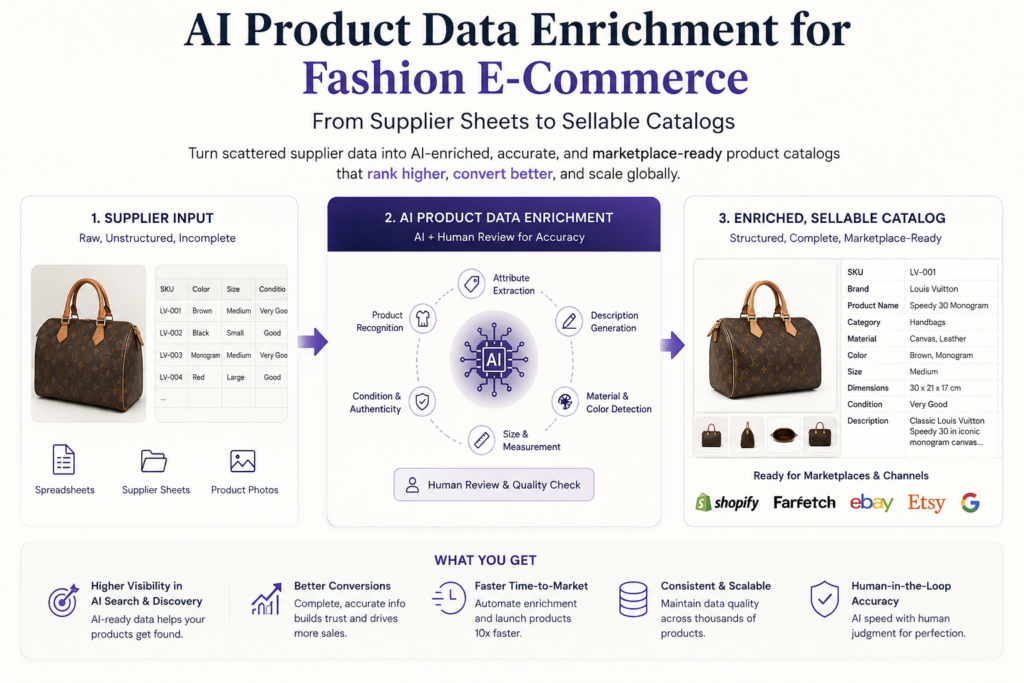
A catalog specialist could ask which products from a supplier batch are missing required attributes. Tools could retrieve the batch, list validation failures, and submit proposed corrections to a review queue.
In an AI product data enrichment workflow, retain the source for each suggested attribute and route uncertain details to a person. MCP supplies access to the workflow; extraction, enrichment, and quality checks still require their own implementation. Our guide to product enrichment for fashion e-commerce explores the catalog work in more detail.
Explain Marketplace Publishing Failures
An operations assistant could retrieve a listing’s latest rejection reason and compare it with the internal product record. It might identify a missing size mapping or unsupported condition value, then prepare a correction for approval.
Keep publishing separate from diagnosis. Validate the approved record against the destination channel’s requirements, and track whether the retry succeeded.
MCP and AI Agents: Access Is Only One Part
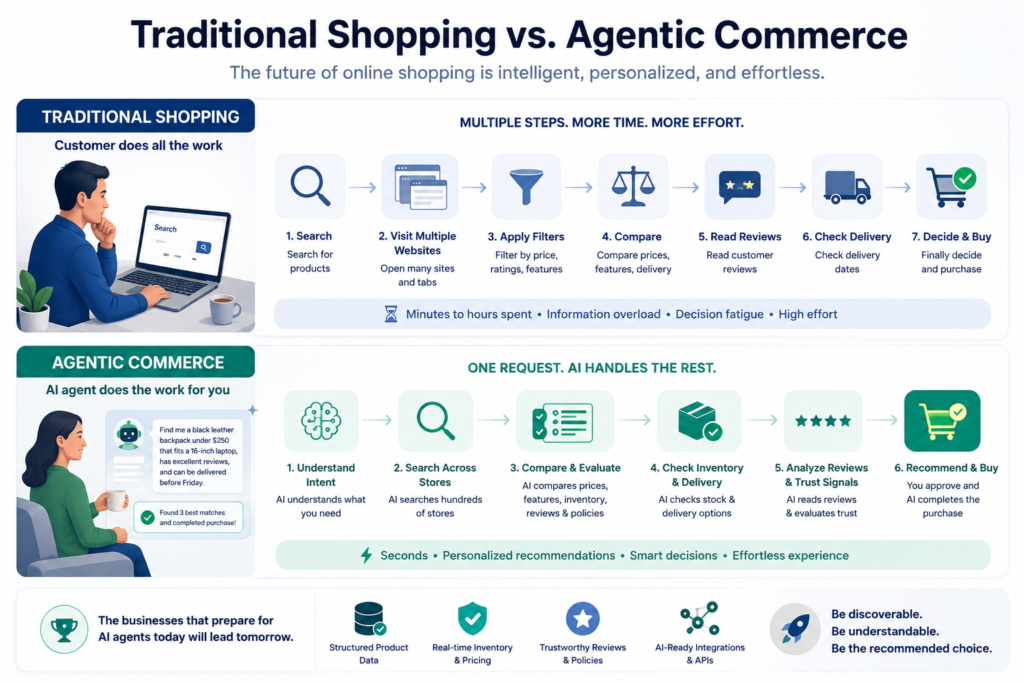
For AI agents to work effectively, they need reliable access to business systems. MCP can provide a communication layer, but agents can also use direct APIs and other integrations. MCP does not supply the planning, judgment, or operational reliability of the agent itself.
Separate read-only tools from tools that change prices, publish listings, cancel orders, or issue refunds. For consequential writes, our recommendation is to show the exact proposed change and require approval before execution. Enforce that approval in the application or backend, rather than relying only on a prompt. Bind approval to the exact records and proposed values, check that the underlying record has not changed, and use a request identifier to prevent duplicate execution. Our guide to AI agents for e-commerce operations covers the wider workflow and approval design.
Security and Data Boundaries
Your implementation should define which information an AI application can retrieve. Permissions can be limited to specific systems, users, or operations. Those limits must be enforced by the implementation; using MCP is not a security guarantee.
The official MCP security guidance addresses risks including excessive scopes and token passthrough. For a commerce implementation, we recommend:
- Least privilege: authorize each operation for the actual user, organization, and permitted records. Do not give every assistant a shared administrator account.
- Credential boundaries: validate tokens for their intended audience, keep downstream credentials on the server, and use encrypted connections for remote access.
- Untrusted input handling: treat supplier files, descriptions, and tool responses as data. Embedded instructions must not override permissions or approve a write.
- Minimal disclosure: return only necessary fields. Review which information reaches the model provider, logs, and storage, along with retention and hosting arrangements for each market you serve.
- Traceability: record the requesting user, tool, approval, affected records, and outcome while keeping secrets out of logs.
Choose explicitly which customer, supplier, and commercial data an assistant may access. Adding an MCP server does not itself establish privacy compliance or a particular data-residency arrangement.
Preparing Your Business for MCP
Businesses do not need to rebuild their technology stack overnight. Preparation begins with understanding existing systems.
Which applications contain valuable information? Which systems already provide APIs? Where is business data duplicated? Which processes still rely on spreadsheets?
Cleaning data, improving documentation, modernizing APIs, and reducing disconnected systems all make future MCP adoption much easier. Start with a bounded pilot:
- Choose one read-only question. Inventory exceptions or listing failures make a more controllable starting point than autonomous price changes.
- Map the source of truth. Agree identifiers, freshness requirements, currencies, time zones, and business definitions before joining records.
- Expose narrow tools. Define required inputs, result limits, timeouts, and explicit error responses. Avoid unrestricted database or arbitrary API access.
- Test failure cases. Include expired credentials, missing pages of results, stale stock, unavailable systems, and attempts to access another organization’s data.
- Measure usefulness. Compare answers with known reports; track completion time, incorrect answers, tool failures, and human corrections.
- Add writes selectively. Design approval, duplicate-request protection, audit history, and recovery before enabling changes.
For the implementation detail behind this starting point, see our read-only MCP inventory pilot guide. This article explains the broader architecture; the pilot guide focuses on one bounded inventory workflow.
What About an Existing Laravel System?
For a Laravel-based commerce application, our recommendation is to expose selected existing business services through an MCP layer. Keep validation and authorization close to those services, and use existing job processing for long-running operations where appropriate. Choose an implementation compatible with the clients you intend to support; do not assume that adopting MCP makes an older application ready without further work.
How CodeNdCoffee Can Help
Implementing MCP is not simply a technical integration project. It requires understanding business workflows, software architecture, APIs, security, and automation.
CodeNdCoffee builds commerce middleware, supplier product-data automation, AI enrichment, marketplace integrations, and custom operational systems. Our A Retro Tale commerce operations case study illustrates connected inventory, catalog, and publishing workflows. It provides context for the systems an MCP layer could expose; it is not presented as an MCP deployment.
If your team is evaluating MCP, discuss one commerce workflow with CodeNdCoffee. Start with the operational question, the systems involved, and the actions that require human approval. That gives you a practical basis for deciding whether MCP is worth adding.
Enjoyed this article?
Share it with your network