
AI Inventory Forecasting for E-Commerce: Reducing Stockouts, Overstock, and Manual Decisions
A practical guide to forecasting e-commerce inventory: connect sales and supplier data, calculate reorder proposals, test model accuracy and keep purchasing decisions under human control.

- 14 Min Read
- Jun 4, 2026
- 198 Views
- What is AI inventory forecasting?
- Why inventory forecasting matters in e-commerce
- Demand forecasts and inventory decisions are different
- How AI inventory forecasting can help reduce stockouts
- How forecasting can help reduce overstock
- What data does AI inventory forecasting need?
- Forecasting for fashion, luxury and one-of-one products
- Connecting Shopify and custom commerce systems
- Evaluate a forecast before trusting its recommendations
- Keep purchasing decisions under human control
- Common mistakes in AI inventory forecasting
- How to start an AI inventory forecasting pilot
- Example: a weekly inventory review workflow
- Building forecasting into commerce operations
- Common questions about AI inventory forecasting
AI inventory forecasting uses demand models and connected commerce data to help e-commerce teams decide what to reorder, when to reorder and which stock needs attention. The forecast estimates future demand; inventory rules turn that estimate into a proposed action.
Stockouts can lose sales, while overstock ties up cash and creates discount pressure. A useful system brings together sales, available stock, confirmed inbound deliveries, supplier lead times and campaign plans. Its recommendations should show their inputs, assumptions and uncertainty.
This guide explains how to build a practical forecasting workflow for Shopify, multi-channel and custom commerce systems. It covers data quality, reorder calculations, model evaluation and approval controls, with illustrative examples rather than claimed client results.
What is AI inventory forecasting?
AI inventory forecasting combines statistical or machine-learning demand forecasts with inventory and supplier information to support purchasing decisions. It can help teams identify stockout risk, slow-moving products and changing demand patterns.
A report shows current or historical stock. A forecast estimates what may happen over a defined period. A replenishment policy then accounts for lead time, safety stock, existing commitments and buying constraints.
These are separate responsibilities. A language model can explain a forecast or draft a management summary, but it should not invent demand figures or calculate purchase quantities without validated tools. Keep calculations in a tested reporting or planning service.
Simple sales-velocity alerts and reorder rules do not require AI. Start with those baselines, then use a more complex model only if evaluation shows that it improves the decisions your team needs to make.
Why inventory forecasting matters in e-commerce
Stockouts can lose sales
A stockout happens when customers want to buy a product, but it is unavailable. It can also waste campaign spend when promoted products cannot be fulfilled. Forecasting helps identify shortages before the team commits to a promotion or misses a reorder window.
Overstock ties up cash
Overstock happens when the business purchases more inventory than it can sell within a reasonable time. It creates storage costs, aging stock and discount pressure.
For fashion e-commerce, overstock is especially risky because trends, seasons, sizes, and styles change quickly. A winter coat that does not sell during winter may require heavy discounting later. A trend-based product may lose demand after a few months.
Supplier lead times create risk
Forecasting is not only about demand. It is also about supply. A product may be selling fast, but if the supplier takes 21 days to deliver, the reorder decision must happen much earlier.
Measure actual time from order placement to usable stock, including receiving and inspection. A supplier’s dispatch date is not necessarily the date inventory becomes available to sell.
Campaigns change the planning assumptions
A product may normally sell two units per day and sell much faster during a promotion. Include confirmed campaign dates, discount levels and comparable past events. Model several plausible outcomes when a new campaign has no reliable history.
Demand forecasts and inventory decisions are different
Demand forecasting predicts how much customers may want to buy. Inventory planning uses that forecast alongside stock and operational constraints to decide what to purchase or move.
For example, a demand forecast might estimate 300 units over a planning period. That alone does not tell you how many units to order. You also need usable stock, reservations, inbound quantities and a target buffer.
Define inventory states consistently across platforms. If “available” stock already excludes reserved units, subtracting reservations again will understate supply. Decide whether return stock is sellable before including it.
E-commerce middleware development addresses the mappings and synchronization needed to combine orders, stock and supplier records across systems. Reliable integration is a prerequisite for reliable planning.
How AI inventory forecasting can help reduce stockouts
Compare stock coverage with replenishment time
Sales velocity means how quickly a product sells over time. As a basic check, divide available units by average daily demand. This estimates days of stock coverage under a constant-demand assumption.
Illustrative example: 18 available units divided by three units per day gives six days of coverage. If new stock takes 12 days to become available, there is a supply gap. Placing a normal order now will not prevent that gap; the team may need an expedited delivery, a warehouse transfer or reduced campaign exposure.
This is a simple coverage calculation, not a trained AI forecast. Promotions, intermittent demand and changing sales patterns can make the average misleading.
Calculate the reorder point explicitly
A basic continuous-review reorder point is expected demand during replenishment lead time plus safety stock. Compare it with inventory position: usable on-hand stock plus eligible confirmed inbound stock, minus outstanding commitments not already excluded.
Illustrative example: five units per day × ten days of lead time + 20 units of safety stock = a reorder point of 70 units. The 20-unit buffer is an assumed policy value, not an automatically optimal safety-stock recommendation.
The threshold says when to review an order. It does not define the order quantity. Scheduled purchasing also needs to account for the interval until the next review.
Turn forecasts into constrained order proposals
For a simplified order-up-to example, assume 300 units of forecast demand over the agreed planning period and a 50-unit ending buffer. There are 120 sellable on-hand units, including 30 committed to existing orders, and no inbound stock. The uncommitted balance is 90, so the preliminary proposal is 300 + 50 − 90 = 260 units.
This assumes the 300-unit forecast excludes those existing commitments and that replenishment arrives in time. Round for case packs or minimum order quantities, then check cash, storage and supplier capacity. Do not treat the calculation as a purchase instruction if the timing cannot be met.
Show uncertainty instead of unsupported probabilities
Forecast ranges can be more useful than a single number. A stockout probability is meaningful only when it comes from an appropriate uncertainty model and is checked against outcomes. Do not display a precise percentage simply because a language model generated one.
Choose safety stock around an agreed service objective and demand and lead-time uncertainty. Fast-selling products do not automatically need the largest buffer; supply variability and the cost of a shortage also matter.
How forecasting can help reduce overstock
Review slow-moving stock and stock age
A product may have high stock but low sales. Compare its sales velocity, age, margin and remaining season before deciding whether to discount, bundle, improve merchandising or pause reordering.
Illustrative example: a product with 180 units in stock and eight sales over 60 days has approximately 1,350 days, or 45 months, of coverage at the same sales rate. It is a simple extrapolation, not a prediction that demand will remain unchanged for nearly four years.
Separate stock aging from demand forecasting: aging reports can be built from inventory transactions without AI. A forecast may add context about likely future demand, but the source calculations should remain inspectable.
Review patterns across categories and variants
Sometimes overstock is not only a product issue. It may be a category issue: too many summer dresses after the season ends, too much stock in one size or color, or too many products from a supplier with weak sell-through.
Review these patterns before the next buying cycle. A discount recommendation should consider margin, brand policy and channel restrictions, then go through the appropriate approval process.
What data does AI inventory forecasting need?
Start with reliable operational records. More data does not automatically produce a better forecast; add signals when they improve evaluation and can be maintained.
- Sales history: product and variant identifiers, quantities, timestamps, channels, prices, cancellations and promotion periods.
- Inventory history: stock states, locations, receipts, reservations, adjustments and periods when products were unavailable.
- Supplier and purchasing data: order dates, actual receipt dates, partial deliveries, confirmed inbound quantities, minimum orders and case packs.
- Product attributes: category, size, color, launch date, season and discontinuation status.
- Returns: timing, quantity, reason and whether an item can return to sellable stock.
- Commercial plans: confirmed campaigns, planned price changes, budgets and storage constraints.
Use stable identifiers, remove duplicate events and agree time zones and units of measure. For US and European operations, align regional campaign calendars and supplier working days. Normalize currencies when comparing inventory costs across markets.
Track the timestamp and source of each input. A forecast based on yesterday’s orders and last week’s stock snapshot may look precise while describing a situation that no longer exists.
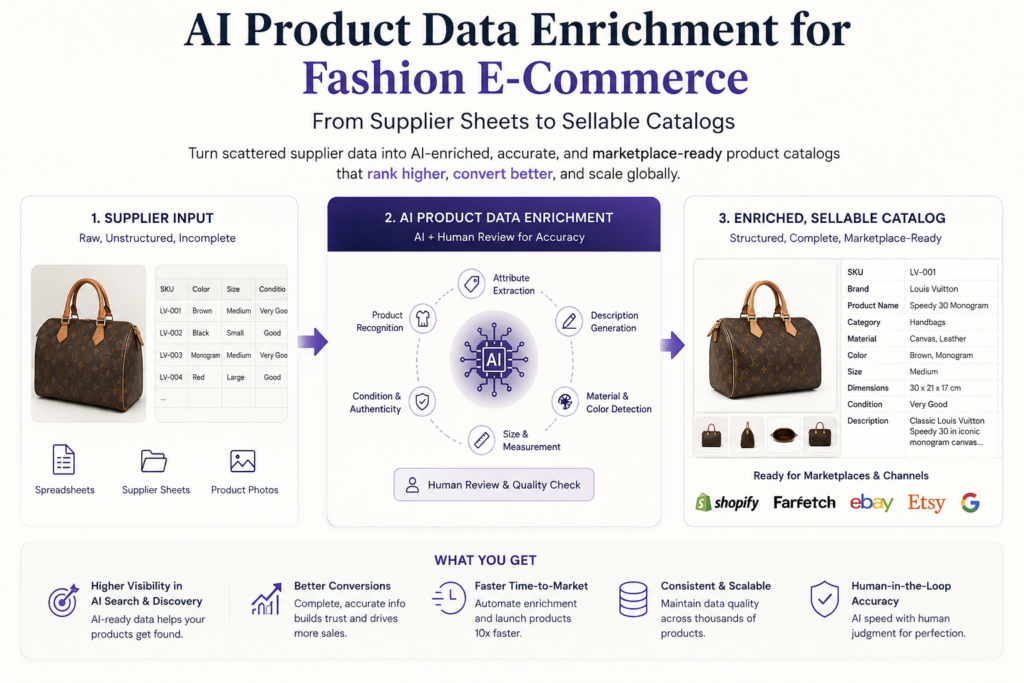
If supplier product attributes are incomplete, our fashion product data enrichment guide explains how to prepare validated category and attribute data. Enrichment supports the data foundation; it does not itself forecast demand.
Forecasting for fashion, luxury and one-of-one products
Fashion inventory is difficult because demand is affected by style, size, color, season, trend, and customer taste. The same garment can have very different sell-through across variants.
Choose the level at which enough evidence exists to make a useful forecast. A frequently replenished item may support SKU-level planning. A new collection or sparse size variant may need category-level information and buyer judgment.
For luxury and vintage fashion, forecasting can be more complex because many products are unique or limited in quantity. In that case, forecasting may focus less on replenishing the same SKU and more on category demand, brand demand, price ranges, sourcing priorities and likely sell-through.
For example, a resale team might investigate whether black shoulder bags sell faster than beige totes in its own records. That is a question to test, not a universal market fact. The forecast cannot create a reliable replenishment plan for a unique item that cannot be sourced again.
For new products, combine comparable-item history with explicit assumptions and review. There is no single minimum number of historical months that guarantees useful forecasting for every catalog.
Connecting Shopify and custom commerce systems
A Shopify-based forecasting workflow may combine store orders, variant stock and locations with supplier purchase orders, returns and external marketplace sales. Confirm access permissions and historical coverage before choosing a model.
A custom operational platform can make the recommendation available where buyers already review suppliers and purchase orders. The choice of Laravel, Vue or another application framework does not by itself make the forecast more accurate.
Use maintained integrations, reconcile transactions and show incomplete imports as explicit errors. Keep approved stock updates separate from forecasts; a predicted sale must not reduce actual inventory.
Our A Retro Tale commerce operations case study provides context on connected catalog, inventory and order workflows. It is not presented as evidence of deployed forecasting models or measured forecasting gains.
Evaluate a forecast before trusting its recommendations
Our recommendation is to compare the proposed model with a simple baseline, such as recent average demand or a seasonal-naive forecast. A complex model is useful only if it improves the relevant decision at an acceptable operating cost.
Backtest using information available at the time
Train on earlier periods and test on later periods, repeating the process at successive dates. Match the forecast horizon to the buying decision, including supplier lead time. Randomly mixing future observations into training can give misleading results.
Hyndman and Athanasopoulos describe this rolling-origin approach in Forecasting: Principles and Practice: time series cross-validation. A good fit to historical data is not enough to establish useful future forecasts.
Measure errors and operational outcomes
- Forecast error: review absolute errors in units and whether the model persistently over- or under-forecasts.
- Segment performance: check fast movers, sparse-demand items, variants and seasonal groups separately.
- Business outcomes: track stockout days, excess stock, emergency orders, inventory value and review time.
- Recommendation quality: record overrides, rejected proposals and why managers disagreed.
Do not summarize performance as “95% accurate” without defining the metric, horizon and test set. A model that improves average error can still make costly mistakes on important products. Evaluate the buying policy as well as the demand model.
Keep purchasing decisions under human control
AI inventory forecasting should assist decision-makers, not blindly make purchasing decisions. Buyers may know about supplier disputes, quality concerns or upcoming campaigns that have not yet entered the system.
Show the input timestamps, forecast period, estimated demand, stock position and proposed quantity together. Route high-value orders, unusual forecasts and missing-data cases for review.
Approval must be enforced in the purchasing workflow. Record who approved the proposal, prevent duplicate purchase orders and confirm what reached the supplier. A prompt telling an assistant to “ask first” is not an adequate backend control.
Common mistakes in AI inventory forecasting
Forecasting from incomplete sales history
If a product sold only ten units because it was out of stock for half the month, the system may think demand is low. In reality, demand may have been higher. This is called censored demand.
A strong forecasting system should account for stockout periods. Record the missing availability and test how it is handled; observed sales alone do not reveal exactly how much demand was lost.
Ignoring supplier lead time
Demand forecasting without supplier lead time is not enough. A product may need a reorder today even if it still has stock, because the supplier takes three weeks to deliver.
Treating all products the same
Fast-moving products, seasonal products, new products, long-tail products and one-of-one products behave differently. Use suitable methods and review rules for each group rather than forcing every item into the same model.
Assuming every forecast should become an order
A reorder may look sensible from a stock perspective but be unsuitable for cash flow, minimum-order rules or warehouse capacity. Forecasts inform buying policies; they do not replace those constraints.
Assuming the model improves automatically
Monitor errors and changes in demand patterns. Retraining, feature changes and policy adjustments need evaluation before release. New data does not guarantee that the next version will perform better.
How to start an AI inventory forecasting pilot
- Choose a bounded decision. Start with a replenishable category, a defined warehouse scope and an agreed planning horizon.
- Reconcile the inputs. Validate product identity, availability history, returns, commitments and confirmed inbound stock.
- Establish a baseline. Document today’s planning method, forecast errors and operational outcomes.
- Test a candidate model. Use historical backtests and inspect exception cases, especially stockouts, new products and promotions.
- Run in review mode. Produce recommendations without creating supplier orders. Record buyer decisions and corrections.
- Expand selectively. Add controlled purchase-order drafting after data quality and usefulness are demonstrated.
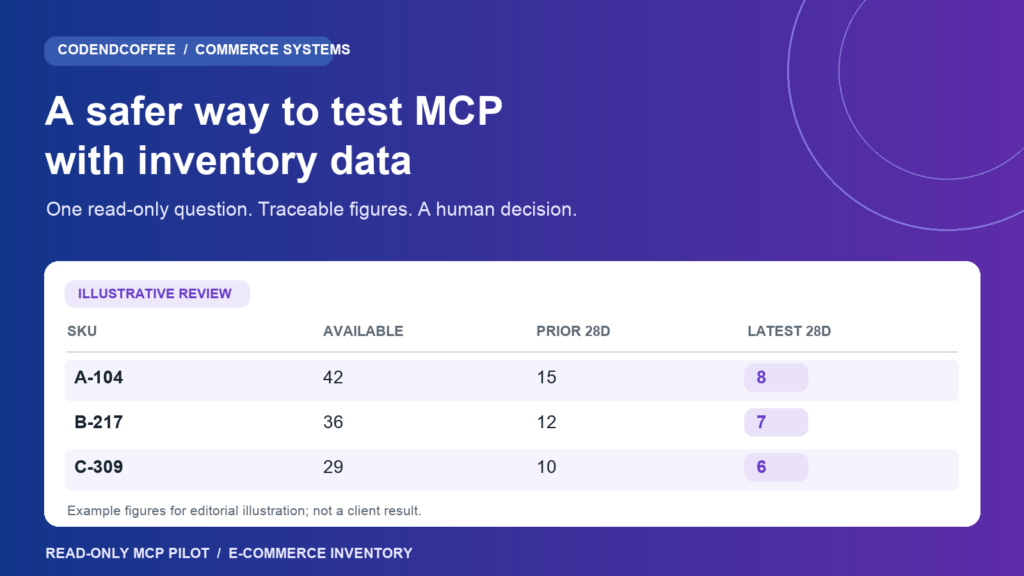
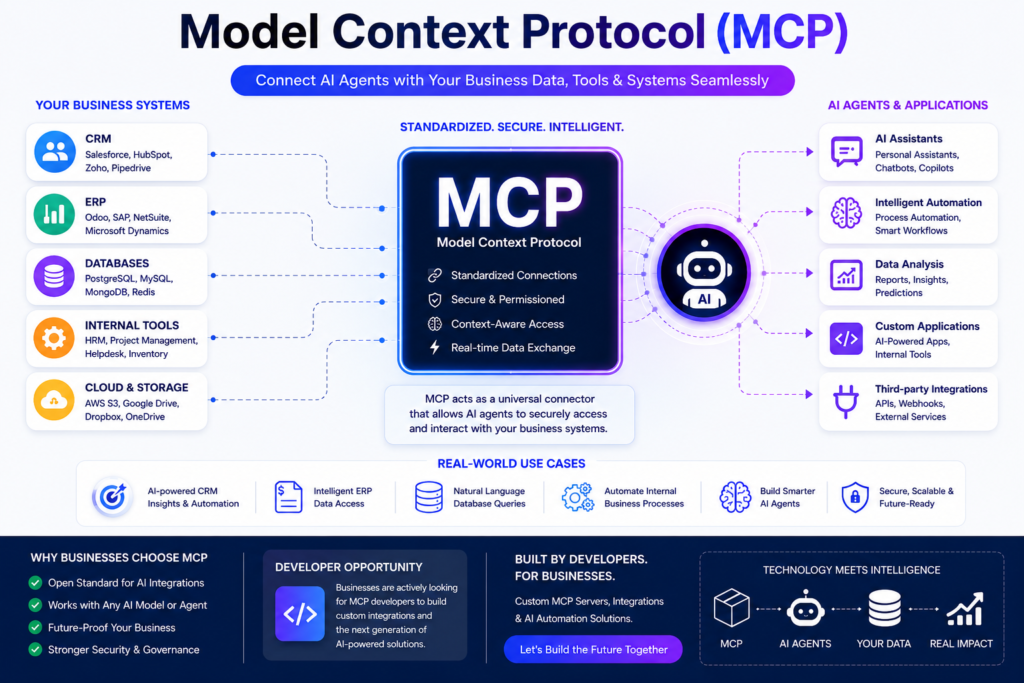
A read-only assistant can help teams inspect the connected information before automating purchases. Our MCP inventory pilot guide explains that access pattern. MCP supplies an interface to selected tools; it is not a demand forecasting model.
Example: a weekly inventory review workflow
This is an illustrative workflow for a fashion store selling through its website, a marketplace and B2B orders. It is not a client result.
- The reporting service imports sales, inventory movements, returns and confirmed supplier deliveries, then checks freshness and reconciliation.
- The forecasting service estimates demand for the agreed period, with a baseline comparison and uncertainty where supported.
- The planning rules compare forecasts with inventory position, lead time, safety stock, pack sizes and budget.
- The dashboard highlights shortages, excess stock and incomplete-data exceptions. Each recommendation links to its source records.
- A buyer reviews the explanation and edits or rejects the proposed quantity.
- After approval, the purchasing workflow creates one tracked purchase-order draft.
- The team reviews actual demand, supplier receipts and policy outcomes in the next cycle.
An AI assistant may explain the exceptions in plain language. The forecast engine and business services remain responsible for the numbers and execution.
Building forecasting into commerce operations
CodeNdCoffee builds connected inventory, supplier, catalog, marketplace and reporting systems. Forecasting fits into that work when the business has a clear planning problem and reliable operational data.
The first step is to map how products are bought, how stock moves and how approvals work. Then define an integration and pilot scope, including how recommendations will be tested and maintained.
If disconnected systems are making inventory decisions difficult, discuss your inventory workflow with CodeNdCoffee. Bring one category, the current planning process and the supplier constraints you need the system to respect.
Common questions about AI inventory forecasting
Can AI inventory forecasting eliminate stockouts?
No. Forecasting can help teams detect risk and plan earlier, but supplier disruption, unexpected demand and data errors remain possible. Assess the forecast and replenishment policy against measured outcomes.
Do reorder calculations require AI?
No. Coverage, stock aging and basic reorder points can be calculated with standard business rules. AI or machine learning may add value when it improves a tested demand forecast or helps explain operational exceptions.
Can forecasting work for unique resale products?
It can support category-level sourcing and sell-through analysis. A one-of-one item usually cannot be treated as a repeatedly replenishable SKU, so the planning level and assumptions need to change.
Should a language model create purchase orders automatically?
Our recommended starting point is read-only analysis and reviewed proposals. Use tested calculations, scoped permissions, enforced approvals and duplicate-request protection before allowing consequential writes.
Enjoyed this article?
Share it with your network