
AI Product Data Enrichment for Fashion E-Commerce
A practical guide to fashion product data enrichment: source evidence, attribute validation, human review and publishing across commerce platforms and marketplaces.

- 15 Min Read
- Jun 29, 2026
- 415 Views
- What Is AI Product Data Enrichment?
- Why Product Data Is Difficult in Fashion Ecommerce
- How AI Product Data Enrichment Works
- What Fashion Product Attributes Can Be Enriched?
- Example: Before and After AI Product Data Enrichment
- Human Review Is Part of Good AI Enrichment
- A Real Product Enrichment Workflow: A Retro Tale
- What We Learned From Building Product Enrichment Into a Real Commerce Workflow
- Product Data Enrichment for Shopify and Headless Commerce
- AI Product Enrichment for Marketplace Publishing
- Product Data Enrichment and AI Search
- Common Product Enrichment Mistakes
- How to Measure the Value of AI Product Data Enrichment
- When Should a Fashion Brand Consider AI Product Enrichment?
- How to Start With AI Product Data Enrichment
- Building AI Product Enrichment Into Ecommerce Operations
Fashion ecommerce depends on more than good product photography and basic descriptions. Brands increasingly need structured, searchable, and channel-ready product information that can support onsite search, filters, marketplaces, Google Shopping, merchandising, and AI-powered discovery.
AI product data enrichment uses computer vision, language models, catalog rules, and existing product data to turn incomplete supplier information and product images into structured ecommerce attributes.
For fashion brands, that can mean extracting or improving information such as material, colour, pattern, category, style, fit, dimensions, condition, product titles, descriptions, and marketplace attributes.
But effective product enrichment is not simply about asking AI to write better descriptions. The real value comes from connecting AI with supplier data, product images, ecommerce taxonomy, business rules, human review, and publishing workflows.
At CodeNdCoffee, we build these workflows as part of broader ecommerce operations, including supplier processing, catalog preparation, inventory systems, Centra, Shopify, and marketplace integrations.
If you are evaluating enrichment for your own catalog, explore our AI Product Data Enrichment Services.
What Is AI Product Data Enrichment?
AI product data enrichment is the process of improving, completing, standardizing, and structuring product information using artificial intelligence, automation, and catalog rules.
A product may initially arrive with only:
- SKU
- supplier reference
- brand
- basic product name
- price
- size
- several images
- short supplier description
That may be enough to identify the item internally, but it is rarely enough for a modern fashion catalog.
A complete product record may also need:
- category and subcategory
- material
- colour
- pattern
- style
- fit
- neckline or sleeve type
- dimensions
- condition
- model or variant
- merchandising tags
- SEO title and description
- marketplace-specific fields
- image alt text
AI can help prepare these fields. A reliable workflow combines automated extraction with validation rules and human approval, particularly where product accuracy affects pricing, authenticity, condition, or marketplace acceptance.
Why Product Data Is Difficult in Fashion Ecommerce
Fashion catalogs contain far more variation than a simple SKU-title-price structure suggests.
Product information can arrive from suppliers in spreadsheets, purchase orders, invoices, PDFs, APIs, email attachments, or image folders. Different suppliers may describe the same attribute differently.
One supplier may use Black, another may use Noir, another may use BLK, while another may provide no colour value at all.
The same problem appears with categories, materials, sizes, product models, and style terminology.
Slow Product Publishing
Catalog teams often spend significant time copying, cleaning, and completing product information before listings can be published.
Inconsistent Attributes
Manual catalog entry can create different naming conventions across products and suppliers.
Weak Filtering and Discovery
A product cannot reliably appear in a “black leather shoulder bags” filter if colour, material, and bag type are not structured consistently.
Marketplace Issues
External channels often require specific categories and attributes. Missing or inconsistent information can create failed listings or additional manual work.
Poor Machine Understanding
Search engines, recommendation systems, and AI shopping experiences perform better when product information is explicit and structured rather than hidden inside vague descriptions.
This is also why product data has become increasingly important for AI-powered search and Generative Engine Optimization. We cover that topic separately in our guide to Generative Engine Optimization for Ecommerce.
How AI Product Data Enrichment Works
A reliable enrichment workflow usually combines multiple data sources rather than depending on a single AI prompt.
Supplier data → product images → AI extraction → catalog rules → confidence checks → human review → ecommerce platform → marketplaces
Each layer has a different responsibility.
1. Supplier and Source Data Intake
The process begins with the information already available.
Sources may include:
- supplier spreadsheets
- invoices
- purchase orders
- APIs
- existing product catalogs
- product images
- historical products
- product specifications
The goal is not to replace reliable supplier information with AI.
Instead, existing data becomes the factual foundation from which missing or inconsistent information can be enriched.
2. Product Image Analysis
Computer vision can identify many visible product characteristics directly from photography.
Depending on the category and image quality, these may include:
- product type
- colour
- pattern
- silhouette
- sleeve type
- neckline
- hardware
- bag shape
- surface appearance, with material suggestions treated as unverified
- style characteristics
For fashion, image analysis is especially useful because valuable attributes frequently exist visually even when the supplier has not provided them as structured data.
An image may clearly show that a garment is black, sleeveless, V-neck, patterned, and midi-length, while the supplier file simply says:
Women’s Dress
AI can transform those visual signals into proposed structured fields.
However, not every attribute should be inferred visually. Composition percentages, authenticity, exact dimensions, product condition, and commercially sensitive details may require other data sources or specialist validation.
3. Text and Catalog Enrichment
Language models can work alongside image analysis and structured data to prepare additional information such as:
- improved product titles
- descriptions
- taxonomy suggestions
- merchandising tags
- normalized material names
- normalized colours
- collection suggestions
- SEO metadata
- marketplace titles
- alternative product descriptions
The goal should not be to generate generic marketing copy.
The output should be grounded in the actual product record.
For example, instead of:
Stylish designer bag perfect for any occasion.
a structured catalog with verified material and condition records may support:
Pre-owned black leather shoulder bag with gold-tone hardware and adjustable strap.
The second description contains information that customers, search systems, and marketplaces can actually use.
What Fashion Product Attributes Can Be Enriched?
Different product categories require different schemas.
A fashion enrichment model should therefore be category-aware, rather than applying the same attributes to every product.
| Data Group | Example Attributes |
|---|---|
| Classification | Brand, category, subcategory, model, variant |
| Visual attributes | Colour, pattern, silhouette, neckline, sleeve |
| Physical attributes | Material, fabric, size, dimensions, fit |
| Fashion attributes | Style, occasion, season, collection |
| Resale attributes | Condition, inclusions, authentication information, history |
| Commerce data | Title, description, taxonomy, tags |
| Channel data | Marketplace category, feed attributes, SEO metadata |
For example, a handbag may need:
- material
- bag type
- strap type
- strap drop
- hardware colour
- closure
- dimensions
- condition
- model
- inclusions
A dress may instead need:
- neckline
- sleeve length
- silhouette
- length
- material
- pattern
- fit
- occasion
This is why product enrichment works best when the catalog architecture is defined before AI is introduced.
Example: Before and After AI Product Data Enrichment
This illustrative example is not a client product record. Consider a supplier record that arrives like this:
Raw Supplier Data
SKU: 48592
Brand: Example Brand
Title: Black Bag
Price: €650
Images: 5
Category: Bags
There is enough information to create a record, but not enough to create a high-quality product listing.
Structured Product Record
Brand: Example Brand
Category: Shoulder Bags
Colour: Black
Material: Unverified — supplier evidence or specialist review required
Style: Quilted
Hardware: Gold-tone
Closure: Flap
Strap: Adjustable shoulder strap
Condition: Review required
Title: Example Brand Black Quilted Shoulder Bag
These are proposed fields until validated. Do not add “leather” to the title or description unless a trusted source confirms it. An image can suggest surface appearance, but it cannot reliably establish composition.
The important distinction is that different fields may come from different sources.
Supplier data: brand, SKU, price
Computer vision: colour, bag type, hardware, shape
Existing catalog: model matching or previous variants
AI generation: normalized title and description
Human review: condition, uncertain materials, authenticity-sensitive fields
That provenance matters in production systems.
Human Review Is Part of Good AI Enrichment
One of the biggest mistakes in product enrichment is treating AI-generated data as automatically correct.
A better approach is human-in-the-loop enrichment.
AI handles repetitive preparation and proposes information. Business rules determine which values can proceed automatically and which should be reviewed.
Lower-Risk Fields
- colour normalization
- basic category classification
- formatting
- title structure
- common visual attributes
These may proceed with limited review only after field-level accuracy has been tested on representative products. A model’s self-reported confidence is not a calibrated probability of correctness. Check accepted suggestions against reviewed examples and sample automatically approved output for errors.
Higher-Risk Fields
- authenticity
- exact material
- condition
- dimensions
- product model
- sale price
- luxury item details
These should be validated against trusted data or reviewed by specialists.
The objective is therefore not to remove humans from catalog management. It is to let humans spend their time validating exceptions instead of repeatedly entering predictable data.
A Real Product Enrichment Workflow: A Retro Tale
This is where our experience at CodeNdCoffee differs from treating product enrichment as a standalone AI feature.
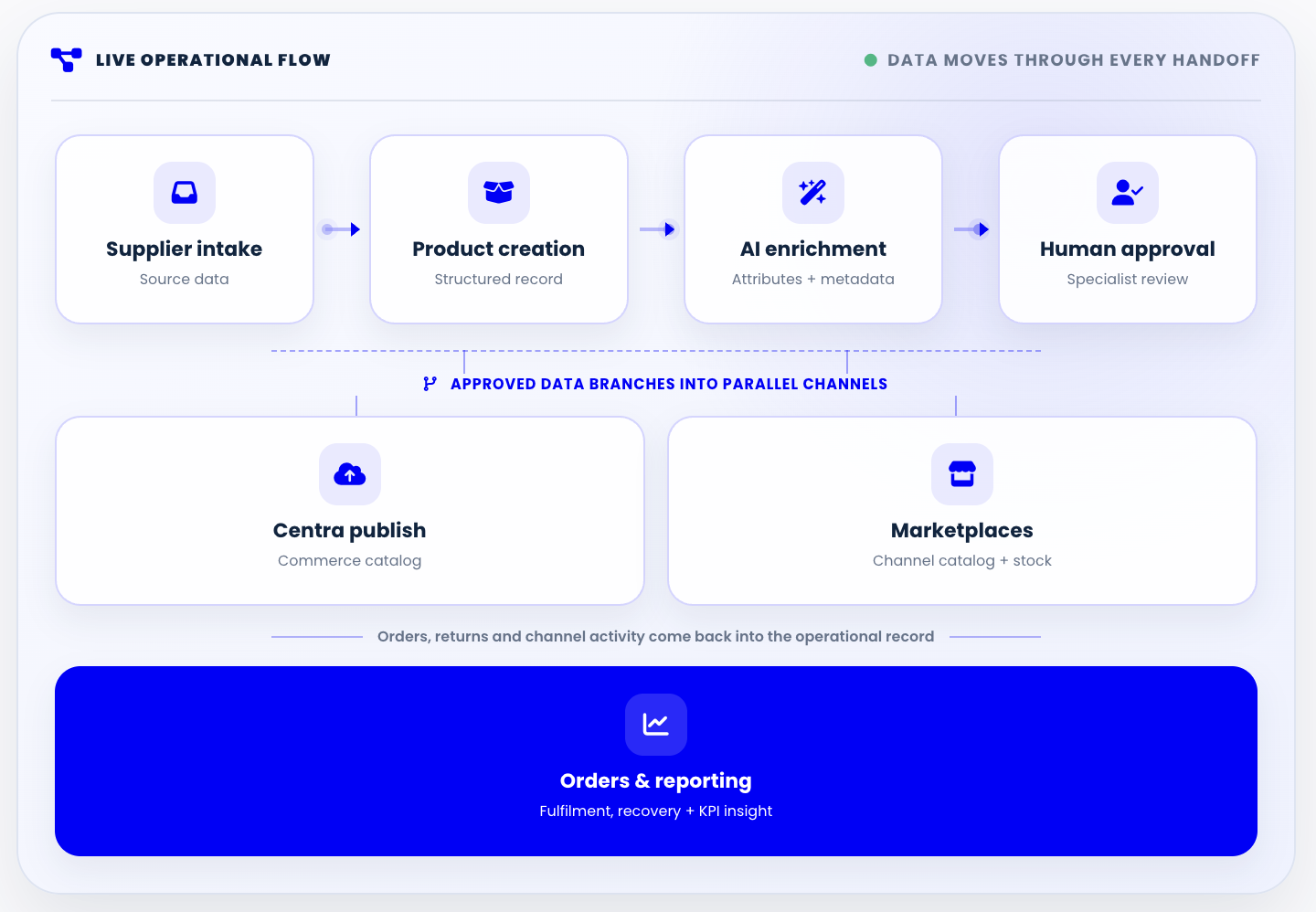
For luxury resale company A Retro Tale, CodeNdCoffee built a connected ecommerce operations platform supporting supplier processing, incoming goods, catalog preparation, AI enrichment, inventory, Centra publishing, marketplace operations, orders, fulfilment, and reporting.
The product workflow connects:
Supplier intake → product creation → AI enrichment → specialist review → Centra publishing → marketplaces → orders and reporting
A separate AI processing layer uses supplier invoices, purchase orders, and product images to prepare product intelligence.
Depending on the product, the system can suggest information including:
- brand
- model
- style
- variant
- dimensions
- condition
- material
- sale price
- titles
- descriptions
- metadata
Uncertain or commercially sensitive attributes remain subject to specialist review before publication.
The linked case study describes the broader connected commerce platform, including catalog, inventory and publishing workflows. That operational scope should not be interpreted as a measured increase in revenue caused by AI enrichment.
The value of enrichment came from making it part of the complete product lifecycle instead of creating another disconnected AI tool.
Explore the complete implementation in our A Retro Tale luxury resale ecommerce case study.
What We Learned From Building Product Enrichment Into a Real Commerce Workflow
Working with complex fashion and resale catalogs reinforces several practical lessons.
AI Needs Context
A product image alone is often insufficient.
Better enrichment comes from combining:
images + supplier data + previous catalog records + category rules + business logic
Use each source according to its reliability. Conflicting or outdated records should be flagged for review rather than combined into a confident answer.
Category-Specific Prompts and Schemas Matter
The information required for a handbag is different from a watch or dress.
In the A Retro Tale workflow, category-aware processing is used across bags, watches, jewellery, and accessories rather than forcing every item into one generic enrichment structure.
Confidence Should Control Automation
The system should distinguish between a high-confidence observation such as a product being black and a more uncertain prediction about a specific luxury model or variant.
Those values should not follow identical approval rules. Define thresholds from measured accuracy for each category and attribute, preserve the evidence behind suggestions, and send unsupported or conflicting values to review.
AI Should Prepare, Not Invent
If the source data does not prove an attribute, the workflow should either mark it as uncertain or send it for review.
Creating plausible but unsupported product details can damage catalog quality rather than improve it.
Enrichment Must Connect to Publishing
Generating attributes inside a separate AI interface is only half the job.
The approved result needs to flow into the systems where the business actually operates:
- Centra
- Shopify
- PIM
- ERP
- marketplaces
- internal catalog tools
- search
- merchandising
This integration layer is often as important as the AI model itself.
Product Data Enrichment for Shopify and Headless Commerce
The enrichment process is largely platform-independent.
What changes is where structured information is stored and how it moves downstream.
For Shopify, enriched information may populate products, variants, metafields, tags, collections, SEO fields, and product feeds. Shopify’s own developer documentation describes metafields as a way to attach custom structured data to products and other Shopify resources.
For headless commerce platforms such as Centra, enrichment may sit inside a separate operations or middleware layer before approved data is published into the commerce catalog.
In more complex environments, the ecommerce platform may not be the master data source at all.
The architecture may instead be:
Supplier systems → operational middleware → AI enrichment → approval → Centra/Shopify → marketplaces
This approach gives teams greater control over validation, product history, publication status, and multi-channel transformations.
For workflows that extend beyond enrichment, explore our e-commerce middleware development services.
AI Product Enrichment for Marketplace Publishing
Marketplace integrations are only as reliable as the catalog feeding them.
Different channels may require different:
- categories
- titles
- attribute values
- condition formats
- descriptions
- image requirements
A strong product data layer lets the business maintain one controlled product record while preparing channel-specific versions where necessary.
For example:
Website title:
Vintage Prada Black Nylon Shoulder Bag
Shopping feed title:
Prada Black Nylon Shoulder Bag – Pre-Owned Designer Handbag
Marketplace title:
Pre-Owned Prada Black Nylon Shoulder Bag
The underlying product is the same, but presentation and required fields can vary by channel.
This becomes especially important when brands operate across their own ecommerce storefront plus multiple resale or marketplace channels.
Product Data Enrichment and AI Search
Better structured product information also helps prepare ecommerce catalogs for AI-powered discovery.
Search behavior is becoming more conversational.
Instead of:
black leather handbag
a shopper may ask:
Which black leather shoulder bags under €800 are suitable for everyday use?
For a product to become a useful candidate for that query, machines need access to explicit information such as:
- product type
- material
- colour
- price
- dimensions
- style
- condition
- availability
- use case
A vague product description cannot reliably provide that level of understanding.
This is why product enrichment and Generative Engine Optimization increasingly overlap.
Structured product information improves the machine-readable context that search engines and AI shopping systems can use when understanding products.
Google recommends structured product data as a way to help Search understand ecommerce content and product information more accurately. See Google’s Product structured data documentation.
Google also states that the same foundational SEO principles continue to apply to generative Search experiences such as AI Overviews and AI Mode. See Google’s guide to optimizing for generative AI features.
If AI search visibility is a priority, read our deeper guide: Generative Engine Optimization for E-Commerce: How Brands Can Be Found by AI Search.
You may also find our article on Agentic Commerce: How AI Shopping Agents Work in 2026 useful if you are preparing product catalogs for AI-driven shopping experiences.
Common Product Enrichment Mistakes
Letting AI Invent Attributes
Generated information should remain grounded in available product evidence.
Using the Same Schema for Every Category
Fashion catalogs need category-specific attributes.
Generating Generic Descriptions
Product content should communicate real product information rather than filler copy.
Ignoring Taxonomy
A well-written description does not fix inconsistent categories, materials, or attributes.
Automating Without Review Rules
High-confidence repetitive fields and sensitive product information should not necessarily follow the same workflow.
Treating Enrichment as a Standalone Tool
The biggest operational benefits appear when enrichment connects to supplier intake, catalog approval, ecommerce publishing, and marketplace workflows.
How to Measure the Value of AI Product Data Enrichment
The right metrics depend on why you are implementing enrichment.
Operational Metrics
- products processed per day
- time from supplier intake to publication
- manual fields entered per product
- review time
- catalog completeness
- failed publication attempts
Catalog Quality Metrics
- missing attributes
- taxonomy consistency
- duplicate values
- product title consistency
- incorrect classifications
- review rejection rate
Commerce Metrics
- search usage
- filter engagement
- zero-result searches
- product discovery
- marketplace acceptance
- organic impressions
- conversion rate
Avoid assuming that AI enrichment itself causes every commercial improvement.
Its strongest direct impact is usually operational: more complete, consistent, and scalable product information.
That better data can then support search, merchandising, marketplace distribution, and customer experience.
When Should a Fashion Brand Consider AI Product Enrichment?
AI enrichment becomes especially useful when you have:
- hundreds or thousands of products
- frequent supplier imports
- inconsistent supplier data
- large image libraries
- repetitive catalog preparation
- complex product attributes
- multiple marketplaces
- a PIM or custom catalog platform
- human teams spending significant time completing product records
It is particularly valuable for fashion, vintage, and resale businesses because individual products often require more detailed classification and may not arrive with clean manufacturer data.
Smaller catalogs with highly standardized supplier feeds may not need a complex AI workflow.
The technology should solve a real catalog problem, not be introduced simply because AI is available.
How to Start With AI Product Data Enrichment
A practical implementation usually begins with the product data model rather than the AI model.
1. Audit Your Existing Catalog
Identify which fields are consistently available, inconsistent, usually missing, manually created, or required by marketplaces.
2. Define Your Target Schema
Decide what a complete product record should contain for each category.
3. Identify Reliable Data Sources
Determine whether each field should come from supplier data, images, existing catalog records, business rules, AI, or human review.
4. Automate Predictable Enrichment
Start with high-volume tasks where automation has clear operational value.
5. Add Confidence and Validation
Define which outputs can move forward automatically and which require approval. Test representative products across categories, suppliers and image quality. Include missing evidence, conflicting sources and unfamiliar variants; measure incorrect accepted fields as well as review workload.
6. Connect Enrichment to Your Commerce Stack
Approved data should flow directly into the systems that need it, rather than remaining inside a disconnected AI tool.
7. Measure Catalog and Operational Improvement
Use real workflow metrics to determine whether automation is actually reducing work and improving data quality.
Building AI Product Enrichment Into Ecommerce Operations
AI product data enrichment is most useful when it becomes part of the infrastructure behind the catalog.
The goal is not simply to generate more product text.
A mature enrichment workflow should help a business move from:
incomplete supplier information
to:
validated, structured product data
and finally to:
channel-ready catalog information across ecommerce, marketplaces, search, and internal operations.
That requires more than an AI model. It requires data architecture, business rules, ecommerce integrations, validation, and operational interfaces.
CodeNdCoffee builds these systems around existing commerce workflows, including supplier intake, AI image processing, catalog enrichment, human approval, Centra and Shopify integrations, ecommerce middleware, and marketplace publishing.
Explore our AI Product Data Enrichment Services or see how the approach works in a real luxury fashion operation in the A Retro Tale case study.
Enjoyed this article?
Share it with your network