
AI Agents for E-Commerce Operations
A practical guide to AI agents for e-commerce operations: useful workflows, system integrations, human approvals and testing before expanding automation.

- 12 Min Read
- Feb 17, 2026
- 243 Views
- What are AI agents in e-commerce?
- AI agents versus traditional automation
- Practical use cases for AI agents in e-commerce operations
- How an operational agent connects to your commerce systems
- Human approval and security controls
- A pilot workflow for a fashion e-commerce team
- Testing and measuring business value
- Operational agents and AI shopping discovery
- Frequently asked questions
- Planning an e-commerce operations implementation
AI agents for e-commerce operations are software assistants that use a language model and connected tools to investigate tasks, prepare recommendations and, within defined permissions, carry out actions. They can support customer service, product data, supplier communication, inventory monitoring and order exceptions.
For many e-commerce businesses, the biggest growth problem is no longer just launching a store. The real challenge is running the operation behind the store. Teams move between catalogs, warehouse records, helpdesks and supplier messages to answer questions that no single system can resolve.
A useful agent brings that information together for a specific workflow. It still needs reliable source data, enforced business rules and a clear point at which a person takes over. This guide explains where agents can help, what they should not decide alone and how to test a practical first implementation.
What are AI agents in e-commerce?
An e-commerce AI agent uses a model to choose among permitted tools, interpret the results and decide what step to take next. Those tools might retrieve an order, search approved policies, inspect a product record or create a draft task for an operator.
A chatbot describes an interface, while an agent describes how work is coordinated. A chatbot can include agent capabilities; an agent can also run in an internal dashboard or background workflow without a chat interface.
For example, a support assistant could verify a customer’s identity, retrieve an authorized order, check carrier events, consult the current delivery policy and draft a response. It should escalate conflicting records or missing information rather than invent an explanation.
Agents do not automatically learn from every completed task. Persistent memory, feedback collection and model or prompt updates must be designed explicitly. A stored conversation is not evidence that future decisions have improved.
AI agents versus traditional automation
Traditional automation follows a defined path: when stock crosses a threshold, create an alert. An AI-assisted workflow can also interpret an unstructured supplier message or summarize why several records disagree. Use the simplest approach that reliably handles the task.
- Rules and integrations: suitable for stock synchronization, scheduled exports, calculations and other predictable transactions.
- AI-assisted workflows: suitable for extracting information, classifying exceptions and drafting content within a fixed sequence.
- Agents: useful when the next step depends on findings, such as investigating an order exception across several systems.
This distinction follows the workflow and agent patterns described in Anthropic’s engineering guide to effective agents. More autonomy adds testing, cost and failure modes; it is not a requirement for a useful commerce tool.
Keep arithmetic, eligibility checks and permission enforcement in application code. A language model can explain a reorder recommendation, but it should not be the source of truth for stock quantities or financial totals.
Practical use cases for AI agents in e-commerce operations
The examples below describe possible workflows, not CodeNdCoffee client results. Several roles can share one controlled application; you do not need a separate autonomous agent for every department.
Customer support and returns
A support agent can retrieve relevant policies, summarize an order’s history, draft replies and route exceptions to the right team. Access to customer information must depend on verified identity and authorization, not merely possession of an order number.
For returns, it can collect required details and prepare a proposed next step. Refunds, disputed eligibility and unusual cases should follow explicit business rules and approval controls. If a policy is outdated or conflicts with an order record, the assistant should flag the conflict.
Product catalog and marketplace data
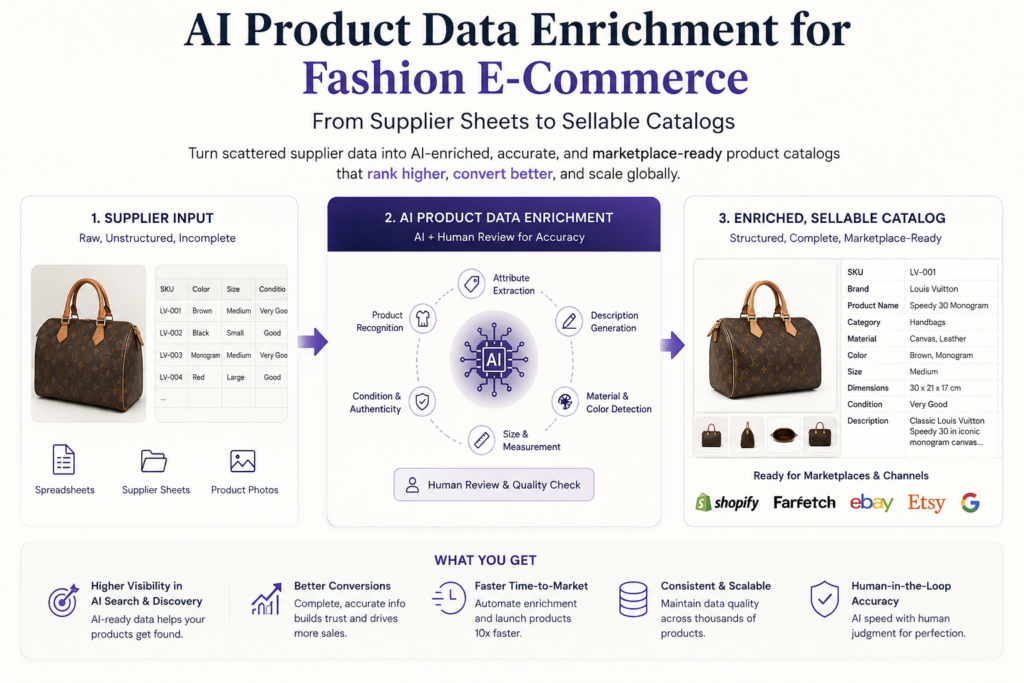
A catalog assistant can detect missing attributes, suggest descriptions from verified source records and map supplier fields to an approved taxonomy. It can also explain marketplace validation errors and prepare corrections for review.
For example, a supplier’s “navy” label may need mapping to a channel’s permitted color value. Preserve the original value and verify the mapping; “navy,” “dark blue” and “midnight” are not always interchangeable. Brand, material, condition and authenticity should not be guessed from an image or incomplete description.
Our guide to AI product data enrichment for fashion e-commerce covers source evidence and review in more depth. For implementation, AI product data enrichment services connect these checks with catalog workflows.
Inventory monitoring and purchasing preparation
An inventory agent can combine stock records, demand forecasts, supplier lead times and open purchase orders to identify items needing attention. It can prepare a purchasing brief and explain the assumptions behind it.
Consider an illustrative item with eight available units, average sales of 3.4 units per day and a 14-day supplier lead time. That is roughly 2.4 days of stock at the assumed rate. Placing an order within 48 hours does not close the supply gap. The workflow should check confirmed inbound stock and options such as expedited supply, transfers or revised availability messaging.
Averages alone are not reliable forecasts. Seasonality, promotions, intermittent demand and periods when an item was unavailable can change the recommendation. See AI inventory forecasting and reorder planning for the forecasting and replenishment distinction.
Supplier communication
A supplier assistant can extract proposed dispatch dates, quantities and SKU references from messages, compare them with purchase orders and draft clarification requests. Store the message timestamp and the original wording alongside extracted fields.
“We will dispatch on Friday” is not a confirmed arrival date. Relative dates need a known reference date, and the receiving team may still need transit and warehouse intake information. Ambiguous commitments should remain unconfirmed until checked.
Order and fulfillment exceptions
An agent can investigate missing tracking, delayed fulfillment, inventory mismatches or inconsistent payment and order states. It can assemble an evidence summary and recommend the next operational step.
Different billing and shipping countries alone do not prove fraud. An assistant should surface signals for the existing review process rather than independently cancel an order. Address changes, cancellations and customer notifications need their own authorization rules.
Reporting, marketing and merchandising
A reporting assistant can answer questions using approved metrics, show the reporting period and link back to underlying records. Financial and inventory calculations should come from deterministic queries or reporting tools, with currency, timezone and exclusions visible.
It may observe that discounts rose while margin fell, but that does not establish the cause. Product mix, returns, shipping costs and purchase costs may also matter. Separate observations from explanations that still need investigation.
Marketing and merchandising assistants can draft campaign briefs or flag incomplete collections. Publishing campaigns, changing prices and allocating spend should remain behind review controls. Use only the customer data required for the authorized task.
How an operational agent connects to your commerce systems
A practical architecture separates the model’s suggestions from the application’s ability to act. The model receives a task and requests a tool; the application checks the request, retrieves permitted data and returns a structured result.
- Task intake: a staff member or scheduled process submits a bounded request, such as investigating delayed orders.
- Data retrieval: tools read the permitted store, warehouse, carrier or supplier records and include timestamps.
- Interpretation: the model summarizes evidence, identifies gaps and proposes a next step.
- Validation: application code checks identifiers, required fields, current state and business rules.
- Approval and execution: an authorized person reviews sensitive changes before a narrowly scoped tool performs them.
- Verification: the system records the actual outcome, including failures, and reports what changed.
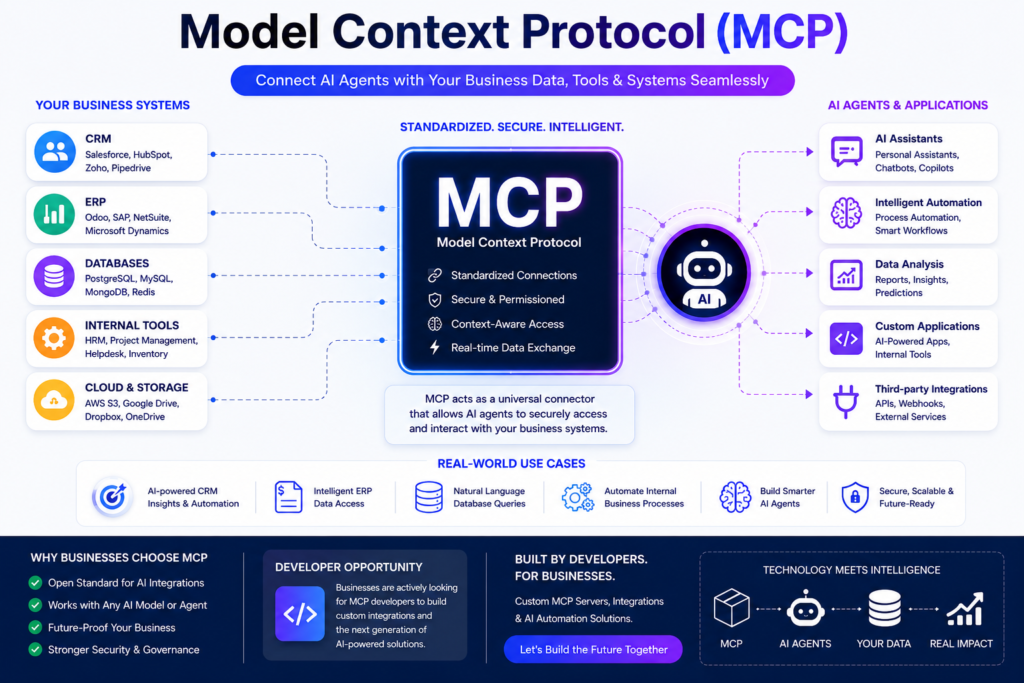
E-commerce middleware development provides the integration layer for this pattern. Direct APIs are sufficient for many projects; Model Context Protocol integrations are another way to expose tools to compatible AI applications. MCP does not replace authentication, validation or approval logic.
For Shopify or a custom commerce platform, available actions depend on the installed systems, API permissions and implemented connectors. Connecting the store does not automatically give the assistant reliable access to every warehouse, helpdesk or marketplace application.
Human approval and security controls
Human-in-the-loop review means an authorized person can inspect the evidence and approve the exact proposed change before execution. It is useful only if the approval is enforced by the application rather than requested in a prompt alone.
- Limit access: give each workflow the minimum tools and records it needs. Enforce customer, organization and role boundaries on the server.
- Separate reading from writing: investigating stock should not grant permission to change prices, issue refunds or submit purchase orders.
- Treat external text as untrusted: supplier emails, product descriptions and uploaded documents may contain instructions that attempt to redirect the agent. They are data, not authorization.
- Validate every action: check tool arguments and current record versions; reject an action if its approved details have changed.
- Handle retries safely: use duplicate prevention for writes so a timeout does not produce two orders or refunds. Confirm the final state before reporting success.
- Keep an audit trail: record retrieved evidence, proposed changes, approvals and execution outcomes. Avoid logging secrets or unnecessary personal data.
- Provide a stop path: set time, cost and tool-call limits, allow operators to pause execution and route unresolved cases to a person.
For businesses operating in the US and Europe, review data locations, retention, vendor access and contractual requirements before sending customer records to a model provider. A particular hosting region or an approval screen does not by itself establish compliance.
Fashion and luxury workflows also need particular care around condition, authenticity and unique items. An AI-generated description should remain traceable to verified records; a recommendation cannot substitute for a specialist assessment.
A pilot workflow for a fashion e-commerce team
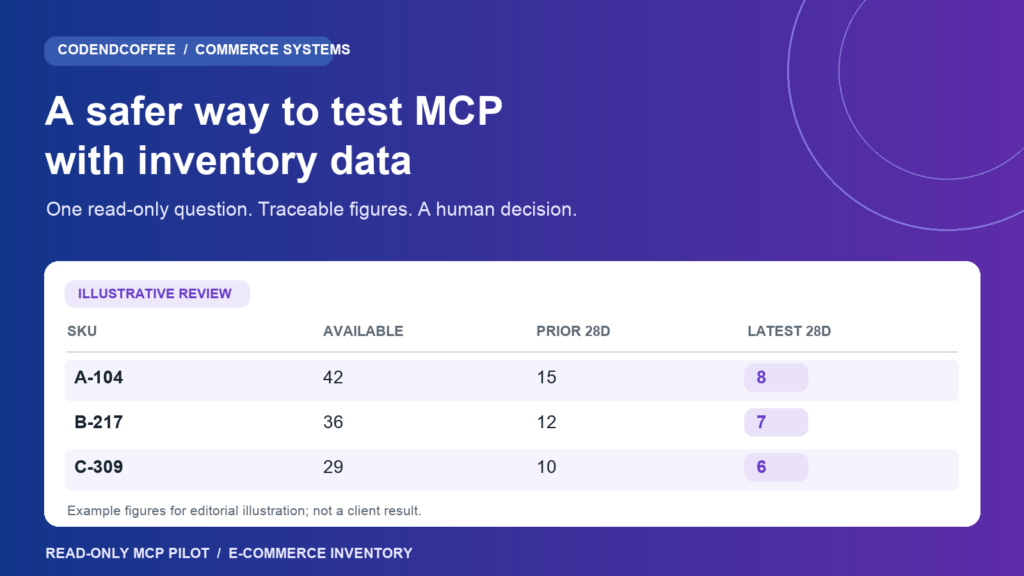
Start with a narrow internal task: prepare a daily stock-risk brief for a selected product group. This is an illustrative design, not a claim about a deployed client system.
- Retrieve available stock, reservations, recent sales and confirmed inbound quantities from the authoritative systems.
- Use a defined calculation or forecasting service to identify exceptions, keeping its assumptions and reporting period visible.
- Have the assistant summarize the exceptions and retrieve relevant supplier messages where permitted.
- Mark missing lead times, unclear dates and stale records as unresolved instead of filling gaps with guesses.
- Present an operator with SKU-level evidence and draft actions. Do not send supplier messages or create purchase orders in the first pilot.
- Record corrections and compare the brief with the team’s existing process before expanding permissions.
A read-only pilot reduces the impact of unintended writes, but access controls and output accuracy still matter. Choose a workflow with enough recurring cases to evaluate and an owner who can judge whether the results are useful.
Testing and measuring business value
Define success before introducing an agent. Measure the current workflow’s handling time, error rate and review burden, then compare equivalent cases after the pilot. Include integration, model usage, monitoring and human correction costs.
- Support: resolution quality, escalation appropriateness, handling time and customer feedback.
- Catalog: accepted suggestions, unsupported attributes, time per approved listing and channel validation failures.
- Inventory: alert usefulness, missed exceptions and purchasing preparation time. Evaluate forecast accuracy separately from the assistant’s explanations.
- Order operations: time to identify an exception, false alarms, duplicate actions and successful resolution.
Build a test set with ordinary cases and difficult ones: ambiguous SKUs, stale policies, restricted customers, missing API results, conflicting stock records and malicious instructions inside supplier text. Check whether the assistant abstains or escalates appropriately.
Test timeouts, rate limits and retries as well as successful calls. Run in a test environment, then observe a limited production pilot with human review. Re-test when tools, policies or model versions change.
Do not count every generated draft as time saved. Count accepted output after review, and track whether faster handling creates more downstream correction work. Any claimed improvement should be supported by measured results rather than a generic percentage.
Operational agents and AI shopping discovery
Internal operations agents help a team run its systems. Customer-facing shopping agents help shoppers research or transact. They share a need for accurate product and availability data, but they address different workflows.
This article focuses on internal operations. For the separate question of how search assistants understand your store, see our guide to generative engine optimization for e-commerce. Having an internal agent does not guarantee visibility or citations in AI search.
Frequently asked questions
What is a useful first AI agent for an e-commerce business?
A bounded internal workflow, such as preparing catalog corrections or summarizing order exceptions, is a practical starting point. Choose based on data quality, recurring workload and whether an operator can verify the output. Keep writes disabled until the workflow is tested.
Can an agent automatically change inventory or issue refunds?
Only if the application exposes and authorizes those actions. Technical capability is not sufficient justification. Stock adjustments and refunds need validated records, business rules, duplicate prevention and approval controls appropriate to their impact.
Does every automation need an AI agent?
No. Predictable synchronization, calculations and scheduled exports are often better handled with conventional integrations. Add AI when interpreting unstructured information or choosing an investigative next step improves the workflow.
Do AI agents require MCP?
No. Agents can use direct APIs or other tool interfaces. MCP can standardize connections for compatible applications, but security and operational controls still need implementation.
Will an agent improve automatically as staff use it?
Not by default. Capture feedback deliberately, review failures and test changes to prompts, tools or models. Memory and feedback systems need explicit design and retention policies.
Planning an e-commerce operations implementation
CodeNdCoffee’s work in product data, supplier automation, marketplace integrations and commerce middleware provides the systems foundation for these workflows. The ART luxury fashion resale operations case study illustrates commerce operations work; it is not evidence of agent deployment or agent ROI.
Begin with one operational bottleneck, identify its source records and define the decisions that remain with your team. If you need help connecting the systems and designing a controlled pilot, discuss your e-commerce operations workflow with CodeNdCoffee.
Enjoyed this article?
Share it with your network